
Converting Files
Convert mode changes a file from one format to another. For example, HEIC to JPEG, WAV to MP3, or MOV to MP4.
How to use
Section titled “How to use”- Make sure you’re on the Convert tab
- Drop files into the window or click Add Files
- Select the output format
- Click Convert
Optional compression during conversion
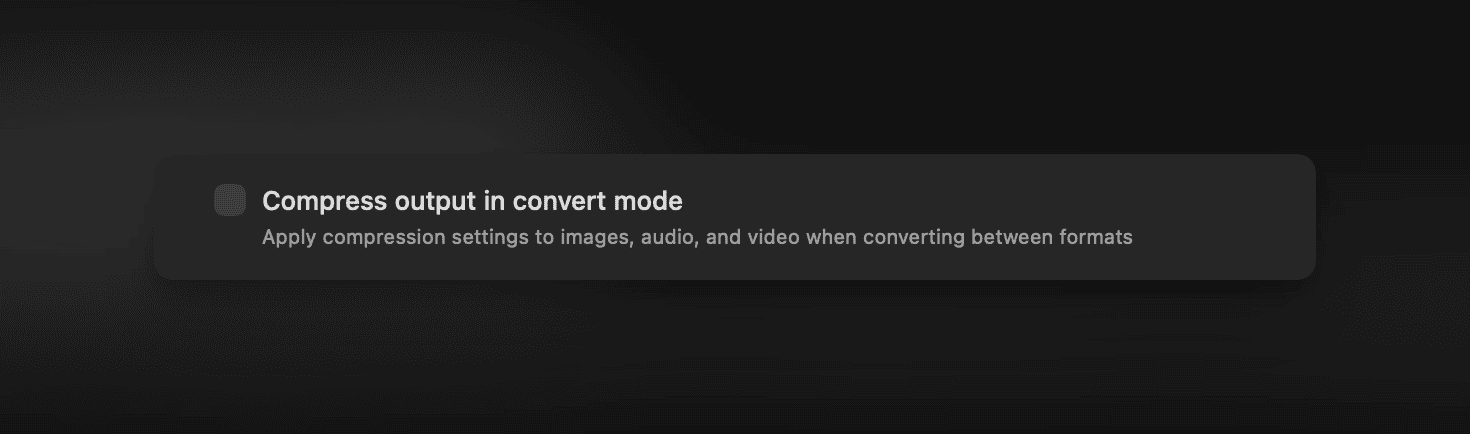
Section titled “Optional compression during conversion”You can apply compression as part of the conversion. Turn on Compress while converting in Settings → General, then adjust the quality slider or pick a preset before converting. This lets you change format and reduce file size in one step.
Remembered output format
Section titled “Remembered output format”Picmal remembers the last output format you selected for each input type. Drop a new file and it automatically picks the same format you used last time, no need to reselect. For example, if you always convert HEIC to JPG, Picmal will default to JPG whenever you drop a HEIC file.
Before/after preview
Section titled “Before/after preview”After converting a file, click the screen icon on any processed file to open an interactive before/after slider. This lets you compare the original and converted versions side by side, useful for checking how a format change affects visual quality.
Same-format conversions
Section titled “Same-format conversions”You can convert a file to the same format it’s already in. Every format lists itself as a target, though it’s never the default pick. This is useful for resampling audio (for example, FLAC to FLAC at a different sample rate) without changing the codec, and for re-encoding an image at your compression quality, a WebP to WebP pass shrinks the file instead of pushing it out to PNG or JPG. Video works the same way: MP4 to MP4 lets you change codec, resolution, or frame rate without leaving the container you started in. Because a same-format pass with compression off can only leave the file the same size or bigger, Picmal always compresses these. Same-format conversions follow your convert naming pattern (default {original}_converted), so the output lands beside the original instead of overwriting it. Adjust the pattern, prefix, or suffix in Settings → Output; see output and naming.
Apple icon files
Section titled “Apple icon files”Drop an .icns in and convert it to PNG, JPG, or any other image format. An icon file holds every size from 16 px up to 1024, and by default you get the largest one, named and placed like any other conversion.
To get a different size, open Settings → Images → Icon output size:
| Choice | What you get |
|---|---|
| Largest available | One image at the biggest size inside the icon. The default. |
| All sizes | One file per embedded size, named <name>-1024x1024.png, <name>-512x512.png, and so on. |
| 1024 px … 16 px | One image at that size, if the icon holds it. |
Sizes stored twice inside the icon (a 256x256 and a 128x128@2x, say) come out once. All the outputs land in the output folder you picked, not next to the source.
This works from the command line too, with the same choice on --icon-size:
picmal-cli convert -i icon.icns -f png -o ~/outpicmal-cli convert -i icon.icns -f png -o ~/out --icon-size 256picmal-cli convert -i icon.icns -f png -o ~/out --icon-size allPicmal reads .icns but doesn’t write it here. To make one from an image, use App Icons.
Format compatibility
Section titled “Format compatibility”Picmal converts within the same media type:
- Image → Image (e.g., PNG → JPEG, HEIC → WebP)
- Audio → Audio (e.g., WAV → MP3, FLAC → AAC), see the audio converter for Mac
- Video → Video (e.g., MOV → MP4, AVI → WebM)
You can also extract audio from video, for example, MP4 to MP3.
Metadata control
Section titled “Metadata control”Choose how metadata is handled during conversion:
| Mode | What It Does |
|---|---|
| Strip all | Smallest files, but removes the original’s camera, date, and copyright info |
| Keep essential | Keeps orientation, color profile, and copyright; drops location and serial numbers |
| Keep all | Preserves all original metadata |
Picmal spells out this trade-off under the picker as you choose, so stripping never surprises you.
Copyright and ownership
Section titled “Copyright and ownership”Add your own ownership details to every image you export. Open Settings → General → Copyright & ownership and fill in any of these fields:
- Copyright notice: e.g.
© 2026 Jane Doe - Artist / Creator: the photographer or author
- Credit: attribution or photo credit
- Contact / URL: a website, email, or phone number
Picmal writes them into the standard EXIF, IPTC, and XMP fields, so other apps (Photos, Lightroom, Finder’s Get Info, stock libraries) read them back. Values you enter always overwrite whatever was on the original.
You only enter this once. Picmal saves it as your default profile and reuses it on every export. Use the Add my copyright to exported images switch to turn it on or off without clearing the fields.
This works in every metadata mode, including Strip all. Strip removes the camera, GPS, and other identifying data, then Picmal stamps your copyright back on, so the output carries only your ownership info and nothing else. To embed copyright on the command line, see the --copyright/--artist flags.
Inspecting metadata
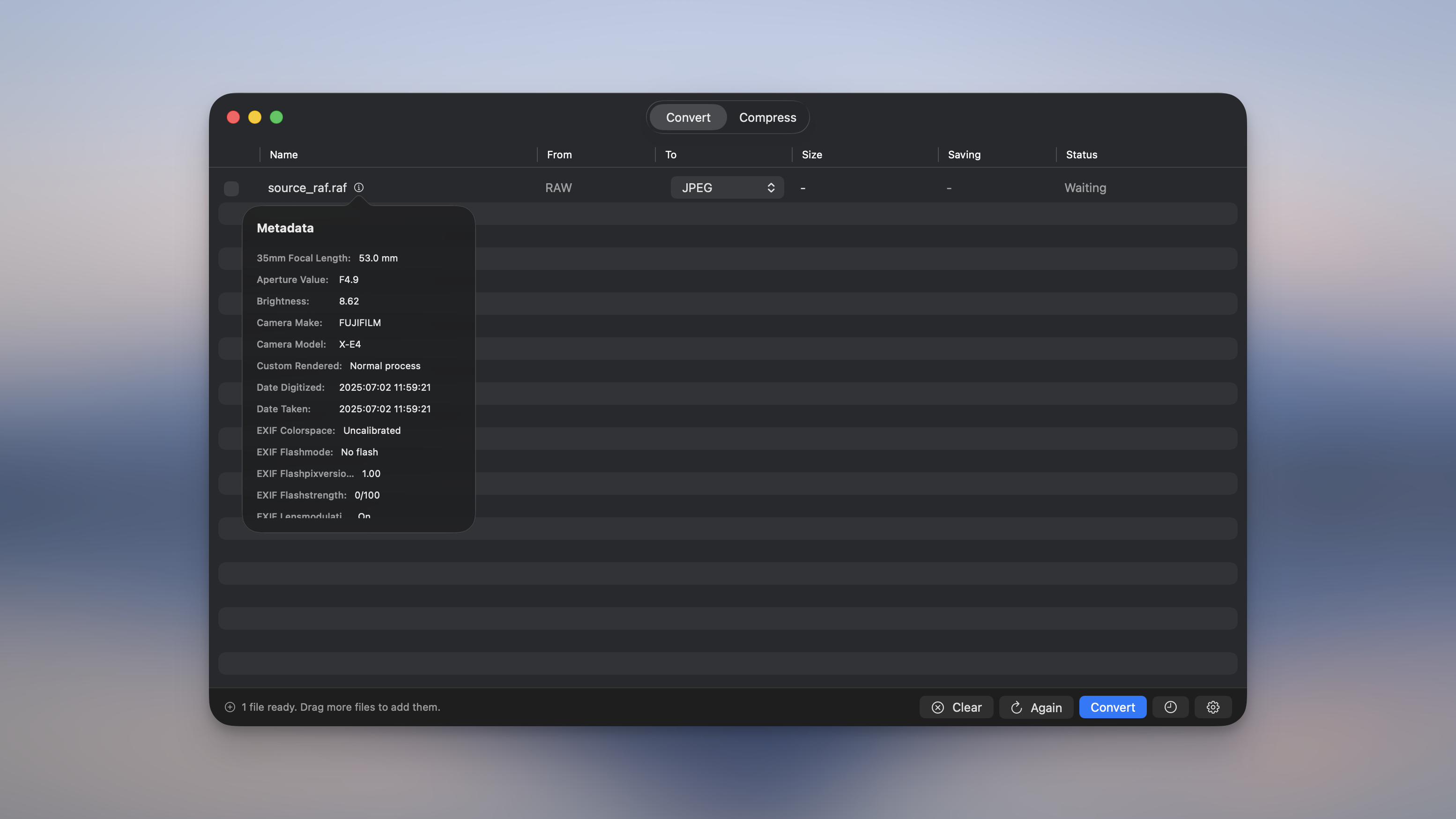
Section titled “Inspecting metadata”Click the ⓘ button next to a file to see its metadata. Before converting it shows the original. Once a file finishes, the popover gains an Original / Result switch and opens on Result (the metadata actually written to the output) so you can confirm at a glance that your copyright landed and that camera and location data came off. The button appears even when the original had no metadata, so copyright you added is always verifiable.
RAW photos
Section titled “RAW photos”Converting RAW photos (NEF, CR2, ARW, RAF, DNG) keeps your camera metadata. With Keep all, the output JPEG carries the make, model, lens, exposure, capture date, and GPS. Keep essential keeps the basics while dropping location and serial numbers. The metadata indicator reads RAW files too, so it shows what’s there instead of appearing empty.
See Supported formats for the full list of input and output formats.
To make files smaller without changing the format, see compressing files.