Changelog

Latest updates, new features, and improvements to Picmal.

As an indie developer, Picmal grows through word of mouth. A review only takes a minute and makes a huge difference.

Leave a Review
v1.8.8 Download

The window stays yours while a batch runs

A release about what happens after you press the button. Dropping a large batch into Compress used to lock the window until the last file was written, and the encoders were fighting Picmal for your Mac the whole time. Both are fixed. While a batch runs, the sidebar now shows a small ring on the tool that’s working, PNG compression is several times faster and finally saves something worth having, and the checkboxes in Convert and Compress decide what runs.

New features

  • The sidebar shows which tool is running. A small ring and a percentage sit beside the tool that’s working, so a batch you started stays visible from anywhere in the app. Convert, Compress, Crop, Split PDF, and Remove Background report a real percentage; the other tools show that they’re busy. See managing the queue.

Improvements

  • Compressing PNGs is far faster, and it actually saves something now. Maximum compression could sit on a single image for minutes and hand it back barely smaller. One squeeze step was spending four to seven times the work for under 1%, and the lossy pass quietly skipped any image it judged hard to shrink. Both are fixed: a 1.8 MB image that used to come back 0.6% smaller now comes back at half the size. See image compression.
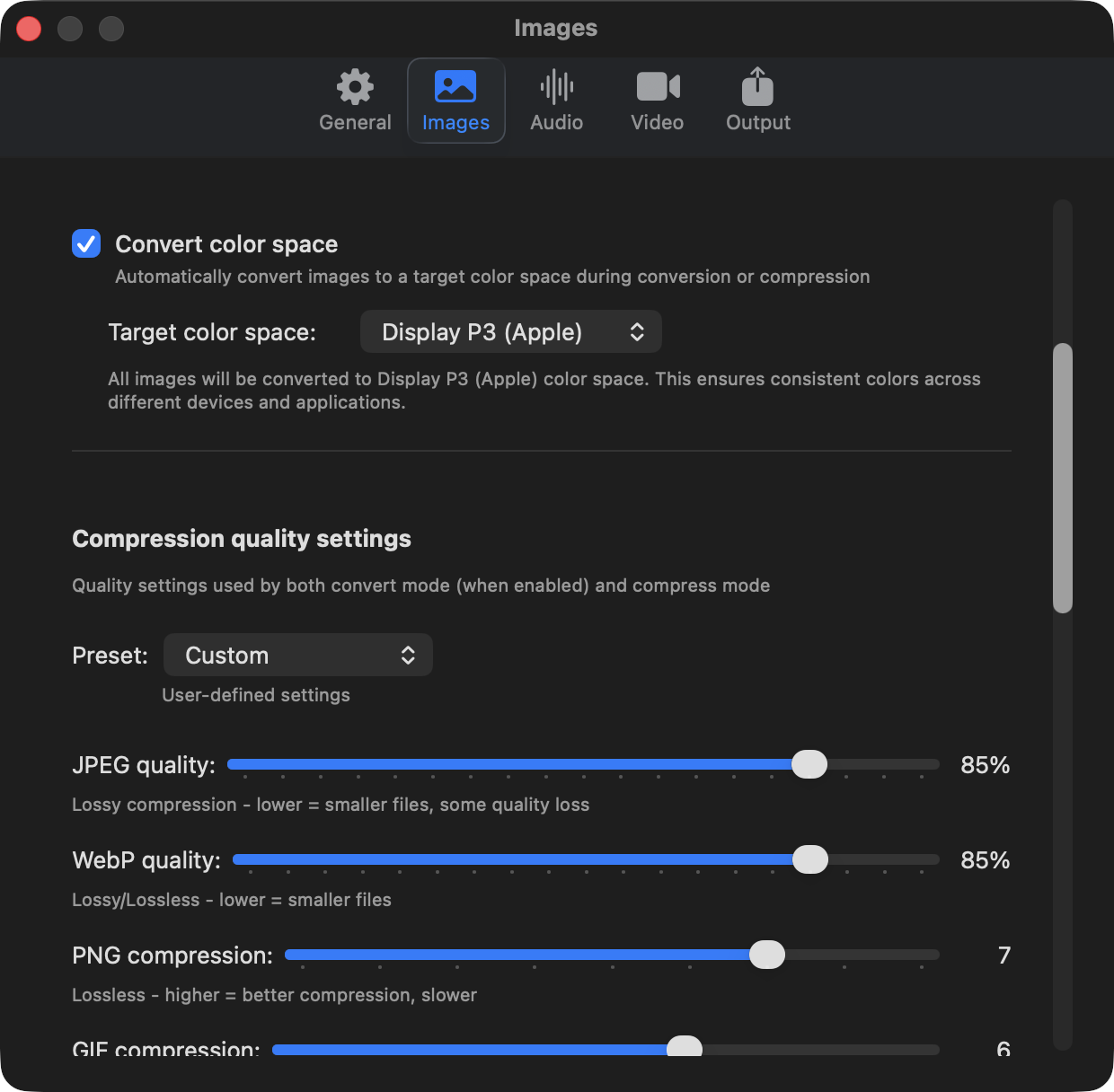
  • Compressing stopped burning a processor core per file for nothing. Picmal watched each running encoder with a loop that spun a core flat out instead of waiting for it, and it read the encoder’s output at a lower priority than the code waiting on that output. A dozen files at once left the encoders fighting Picmal for the machine: the same animated WebP took 25 seconds inside a batch and under 7 on its own.
  • Big batches stop stalling partway through. Reading a file’s metadata, applying a color profile, and setting DPI each tied up one of Picmal’s worker threads until the tool finished. Drop 40 files and every thread was taken at once, so the queue stopped moving while the list looked busy. Those steps now wait out of the way.

Bug fixes

  • Fixed the window freezing for a whole batch. Dropping around 130 images and pressing Compress locked the window until the last file was written: no scrolling, no clicking, no progress. Picmal blocks tool switching during a run by putting the sidebar selection back, and that correction kept re-triggering itself every frame for the length of the batch.
  • Fixed unchecking a file not keeping it out of the run. The checkboxes in Convert and Compress only ever decided what a bulk preset applied to. Tick one file, press Compress, and Picmal compressed the whole list anyway, writing a second copy of files you had already finished. It now runs the files you ticked, and the whole list when you tick nothing. Scheduled jobs no longer sweep up whatever else is sitting in the window, and the progress bar counts the files in the run, so a partial batch reaches 100% instead of stopping short. See managing the queue.
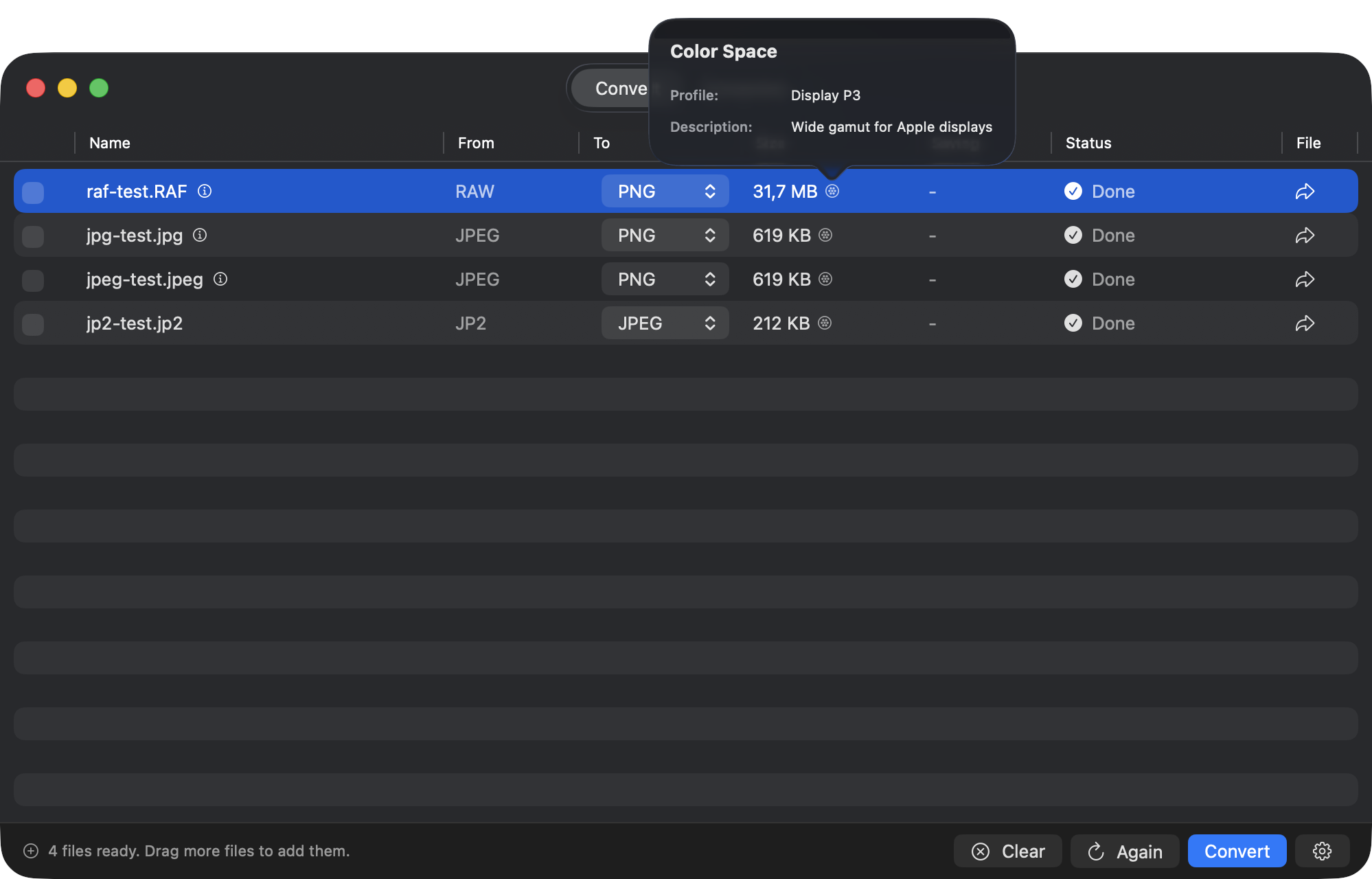
  • Fixed print-ready CMYK images converting with the wrong colors. A CMYK JPEG, the kind that comes out of InDesign or a printer’s proof, turned neon when you converted it to WebP or PNG. The 1.8.7 fix covered wide-gamut RGB photos only, and left CMYK to a built-in guess that ignores the profile inside the file. Picmal now reads that profile and translates the colors properly, whether you strip the metadata or keep it, and a PNG no longer comes out tagged with a CMYK profile it can’t use. Converting CMYK to JPEG, TIFF, or PDF with metadata kept still stays CMYK, for print. See color space.
  • Fixed a row saying “Done” when it wasn’t. Changing a file’s output format, playback speed, or subtitle after it had finished left the green tick sitting there while quietly putting the row back in the queue, so the next run re-encoded a file that looked finished. The tick now clears, and the list matches what the next run will do.
  • Fixed Picmal quitting while you’re using the window. Dragging files onto the list could do it, and so could moving the pointer across the window. Redrawing a row, or routing a mouse movement, could momentarily lose track of Picmal’s settings and close the app on the spot. Those reads now fall back to the settings the rest of the app is already using.
  • Fixed picmal-cli compress handing you a bigger file and calling it compressed. Compressing a PNG from the terminal could return a file 50% larger than the one you gave it, counted as a saving. It now uses the same compression the app does, and when a compressed file would come out bigger, you get the original back untouched. See command line.
v1.8.7 Download

Crop, download videos, and a preset for every file

The biggest release in a while. Two new tools in the sidebar — Crop for images and PDFs, Download Video for grabbing clips off the web — plus a Preset column that lets every file in a batch run at its own quality. Watched folders learned to build PDFs, videos got a separate audio quality slider, and a long list of smaller things got fixed along the way.

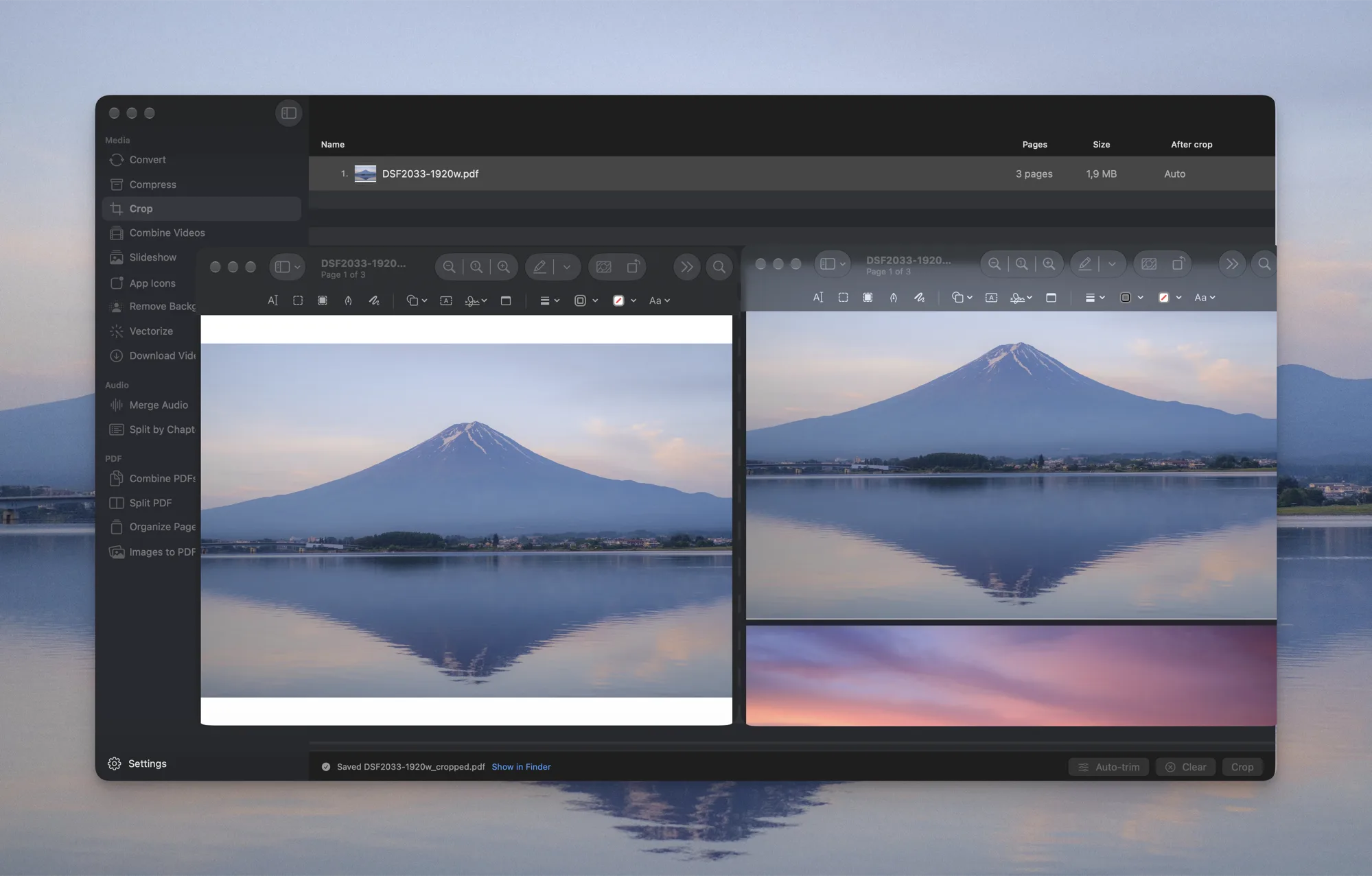
Picmal's new Crop tool with a three-page PDF queued, and two Preview windows side by side comparing the original page against the cropped copy with its white margins gone

New features

  • Crop images and PDFs. A new Crop tool in the sidebar. Drop images or PDFs in, type the margins to remove from each edge — pixels for images, millimeters for PDFs — and Picmal saves a cropped copy next to each original. Turn on auto-trim to strip a solid-color border off images without measuring anything. PDF pages keep their text, links, and forms; only the page size changes. Convert and Compress get a Trim borders switch in Settings → Resize, the terminal gets picmal-cli crop and a --trim flag, and Shortcuts gets a Crop Files action.
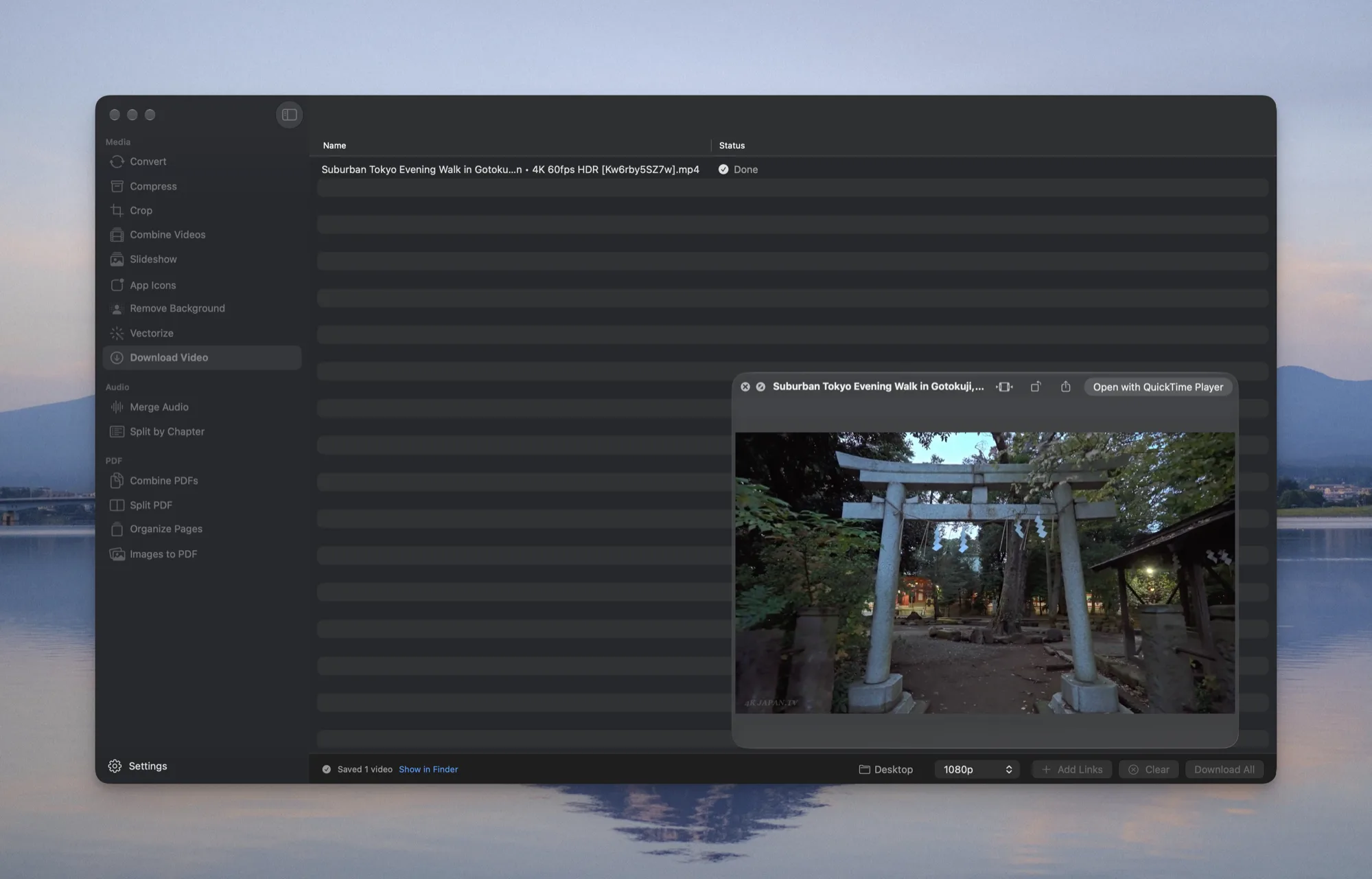
  • Download videos from the web. A new Download Video tool: paste video links, pick where they go, and Picmal fetches them. Drag a link straight from your browser or press ⌘V. Choose Best, 1080p, or Audio only for the whole batch, and watch speed and time remaining on each row. When the batch finishes, a Show in Finder link takes you to the files. Cancelled downloads clean up after themselves and leave nothing half-written next to your finished videos.
  • Downloaded videos open in QuickTime. Sites hand out AV1 and VP9, which QuickTime refuses with “contains some media that isn’t compatible”. Picmal checks each finished file and rewraps it, or re-encodes it when it has to — the row says “Converting” while it works. Files that are already fine are left alone. When a link can’t be fetched, the row says why in plain words: private video, region-blocked, dead link, disk full.

Picmal's new Download Video tool with a finished 4K download marked Done, a QuickTime preview of the clip open over the list, and the destination folder and 1080p quality picker in the bottom bar

  • Pick a compression preset per file. Convert and Compress get a Preset column: each row shows the preset that will run, the one from Settings until you choose another for that file alone. Compress one video hard and keep another balanced in the same batch. Your saved presets are in the menu too, and the Saving estimate updates to match. Tick several rows — Compress now has the same checkboxes as Convert, plus a “Select all videos” shortcut — and the selection bar sets the preset for all of them at once. Pinned rows show a small pin and keep their preset when you change the one in Settings; delete a preset and the rows using it fall back to Settings. A per-file preset changes compression quality only; resize, color, and DPI still come from Settings.
  • Videos get their own audio quality slider. The soundtrack of a converted or compressed video was always written at one fixed quality, whatever the video slider said. Settings → Video → Advanced now has an Audio quality slider in kbps (48–320): push it up for a music clip, pull it down for a talking head. It only applies when the soundtrack is re-encoded, so a plain container change still copies the audio untouched and stays fast. The terminal gets it as --audio-quality on convert and compress.
  • Turn a folder of photos into one PDF, automatically. Watched folders get an Images to PDF action: drop any number of images into the folder and, ten seconds after the last one lands, Picmal writes a single PDF with one page per image, in Finder name order, with the images JPEG-compressed at the quality you pick. Choose Fit to Image, A4, or Letter pages, name the PDF with the usual tokens, and optionally delete the originals once the PDF exists. On the command line, picmal-cli watch add --action images-to-pdf. See watched folders.
  • Combine PDFs from a watched folder. A Combine PDFs action merges every PDF that arrives together into one, in name order. On the command line, --action combine-pdf.
  • Convert a video without changing its format. MP4 → MP4 wasn’t in the To menu, though images have always offered JPEG → JPEG, so changing a video’s codec meant changing its container too. Now it doesn’t. Settings → Video also gets a Copy (no re-encode) codec that carries the picture and sound over untouched: a file that would take minutes to re-encode is done in about a second, at the original quality. When a copy isn’t possible — a container that can’t hold the footage, or a resize, frame-rate, or watermark change that needs a real encode — Picmal encodes with H.264 instead.
  • Run the tool you’re looking at with ⌘↩, and open its file picker with ⌘O. Every tool takes the same two shortcuts. Images to PDF, App Icons, Remove Background, and Vectorize gained a picker of their own — ⌘O used to land in the Convert list behind them — and an empty drop zone now offers a Choose Files… button next to the drag-and-drop hint.
  • Cancel a long job in Merge Audio, Slideshow, and Split by Chapter. Those three ran to the end no matter what. They stop when you ask them to now, on the command line too.
  • Watched folders can ignore files by size. “Before processing” gains a minimum and a maximum: skip the thumbnails, or leave the 4 GB video alone. Blank means no limit.

Improvements

  • Convert and Compress say what a batch did when it finishes. “Done · 12 files converted”, the space you got back, and a Show in Finder link. The line clears when you clear the list or run again. Vectorize gets the same line, and Crop and Split PDF now count done out of total while they run.
  • Better first answers. A JPEG now converts to WebP instead of PNG, which used to make photos bigger. The image quality sliders are always editable and switch to Custom when you move one, the way Audio and Video already worked. Audio and Video gain Reset to defaults, all three remember the preset you used last, and the rare image formats fold away behind Advanced.
  • Picmal tells you what it skipped. Dropping a mixed pile of files onto a tool used to quietly shorten the list. It now says how many files it left out and why — the wrong kind of file, a folder with nothing supported in it, a HEIC or RAW file Vectorize can’t trace, a plain file dropped on Download Video.
  • The fields check what you type, at the field. Negative crop margins, a page size or a playback speed outside what the encoder takes, a page range that doesn’t parse: each one is caught where you typed it, with the range stated (“0.1–8×”) and the run button held until it’s right. Split PDF says “3 ranges” or “Not a valid range” against the shortest document in the list.
  • Error messages read like sentences. A failed write named a full path in a banner too narrow to show it; it names the folder now. The raw FFmpeg output behind a failed Merge Audio, Combine Videos, Slideshow, or Split by Chapter is translated into plain words, and picmal-cli prints the sentence rather than the internal error name.
  • Notifications behave in a batch. Two results in a row stack instead of overwriting each other, and a batch where everything failed says “Failed” instead of announcing that it completed. Nothing beeps while Picmal is the app in front of you — the window already says what happened. If you turned notifications down when macOS asked, results are no longer lost in silence: Picmal plays a sound instead.
  • Watched folders are easier to open and harder to wreck. Double-click a folder or use the chevron to edit it — the editor used to be hidden in the right-click menu. Remove Folder lives in there too, and it, “Clear Processed Files”, and deleting a watermark preset all ask first, because each one is undoable only by hand. Picking a folder that overlaps one you already watch keeps your choice on screen and names the folder it clashes with. The Folders tab and its two sheets now sit on the same background as the rest of Settings, the empty tab reads as a proper “Watch a Folder” screen, and the size limits show “No limit” inside the field rather than as loose text beside it.
  • One name per thing, everywhere. The clipboard feature is Optimize Clipboard in the menu bar and in Settings; “Optimize File…” is now Add Files…, matching the File menu and the Finder service; licensing is Activate License… and Buy License everywhere it appears, and it shows when your license was last checked so the 30-day offline grace isn’t invisible. In Shortcuts, “Make PDF from Images” and “Generate App Icons” are Images to PDF and App Icons, so searching for the name on screen finds the action. On the command line combine is now combine-pdfs and app-icon is app-icons — the old names still work.
  • Picmal’s Finder services only show up for files it can handle. Add Files, Convert, and Compress appeared in the Services menu for folders, archives, and applications, and ended in “Nothing to convert”. They now appear for images, audio, video, and PDFs.
  • Keyboard and VoiceOver reach more of the app. Rows announce their size and whether the file can be read, the icon-only buttons carry labels, and the Copy and ✕ buttons on the clipboard overlay are always there instead of appearing on hover. Empty tooltips are gone.
  • A running batch can’t be pulled apart under it. Backspace, the Remove item, and the options badge are disabled mid-run in the nine list tools, so rows no longer vanish from a batch that’s using them.

Bug fixes

  • Fixed “Process existing files when added” doing nothing. The toggle was saved but never read. It now queues every supported file already in the folder when you add it, and the Edit sheet has a Process Existing Files Now button to run it whenever you like.
  • Fixed converting a large photo to PNG failing. A 24-megapixel photo from a recent iPhone, HEIC or JPEG, would sit there for a minute and come back as “Failed”. Picmal was packing the PNG at a setting that costs five times the work for four percent less size, and it ran out of time before it finished. Those photos convert in a few seconds now.
  • Fixed converting to MJPEG, M2V, or raw HEVC. Those formats are bare video streams with no room for a soundtrack, and Picmal kept trying to write one, so any clip with audio failed. The audio is left out now and the file comes through.
  • Fixed combining videos that carry a thumbnail. Clips saved from Instagram or TikTok often hide their cover image inside the file as a second picture track. Combine mistook that image for the footage, so the result was a two-frame “video” no player would open. The thumbnail is set aside now and the real footage joined, still without re-encoding when the clips match.
  • Fixed Backspace not removing the selected row. Clicking a row selected it but left the keyboard on the sidebar — the row turned gray instead of blue — so Backspace did nothing. Every list and table in Picmal takes the keyboard when you click a row now, in all thirteen tools. Typing in a text field still keeps its own Backspace.
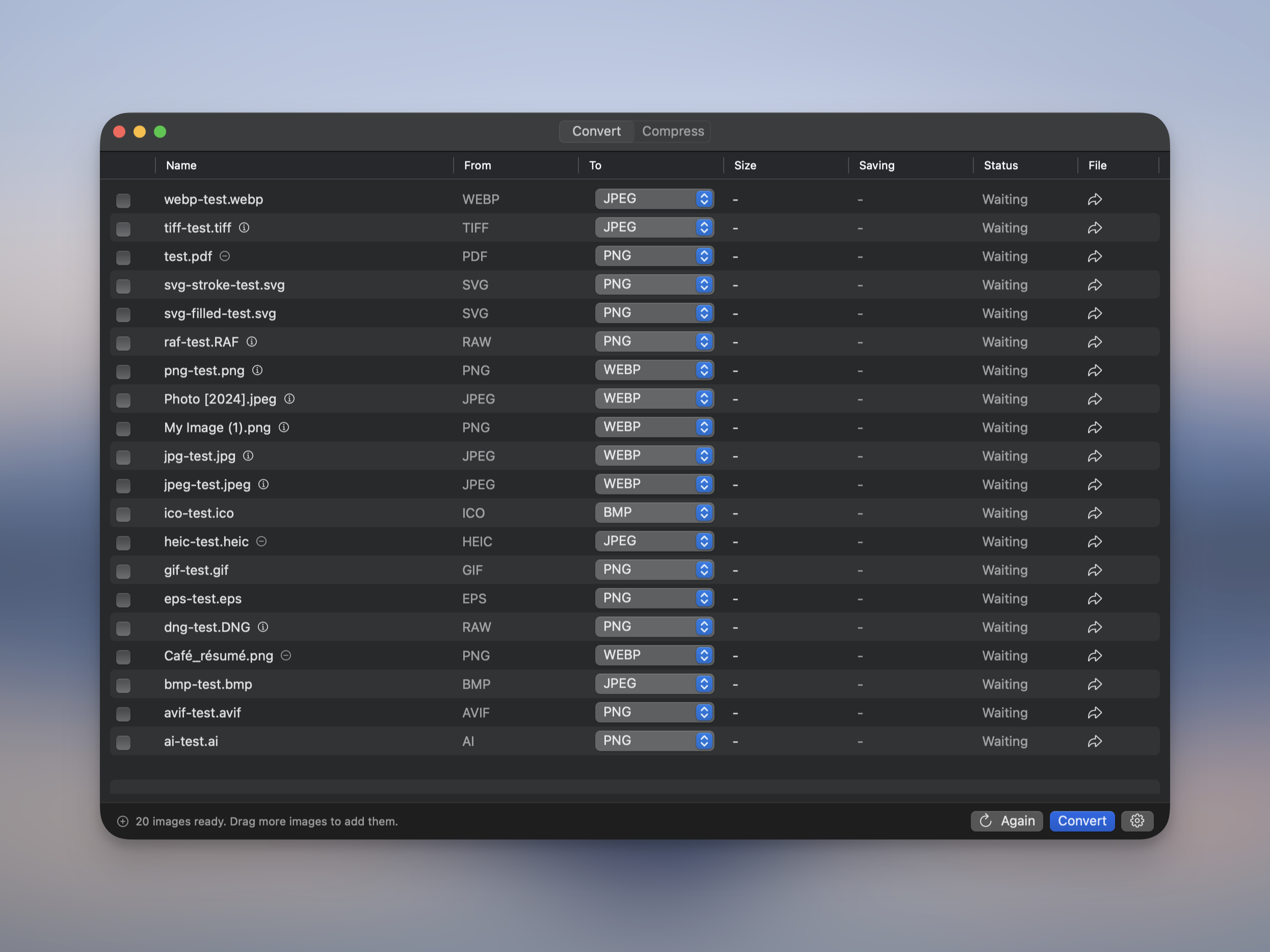
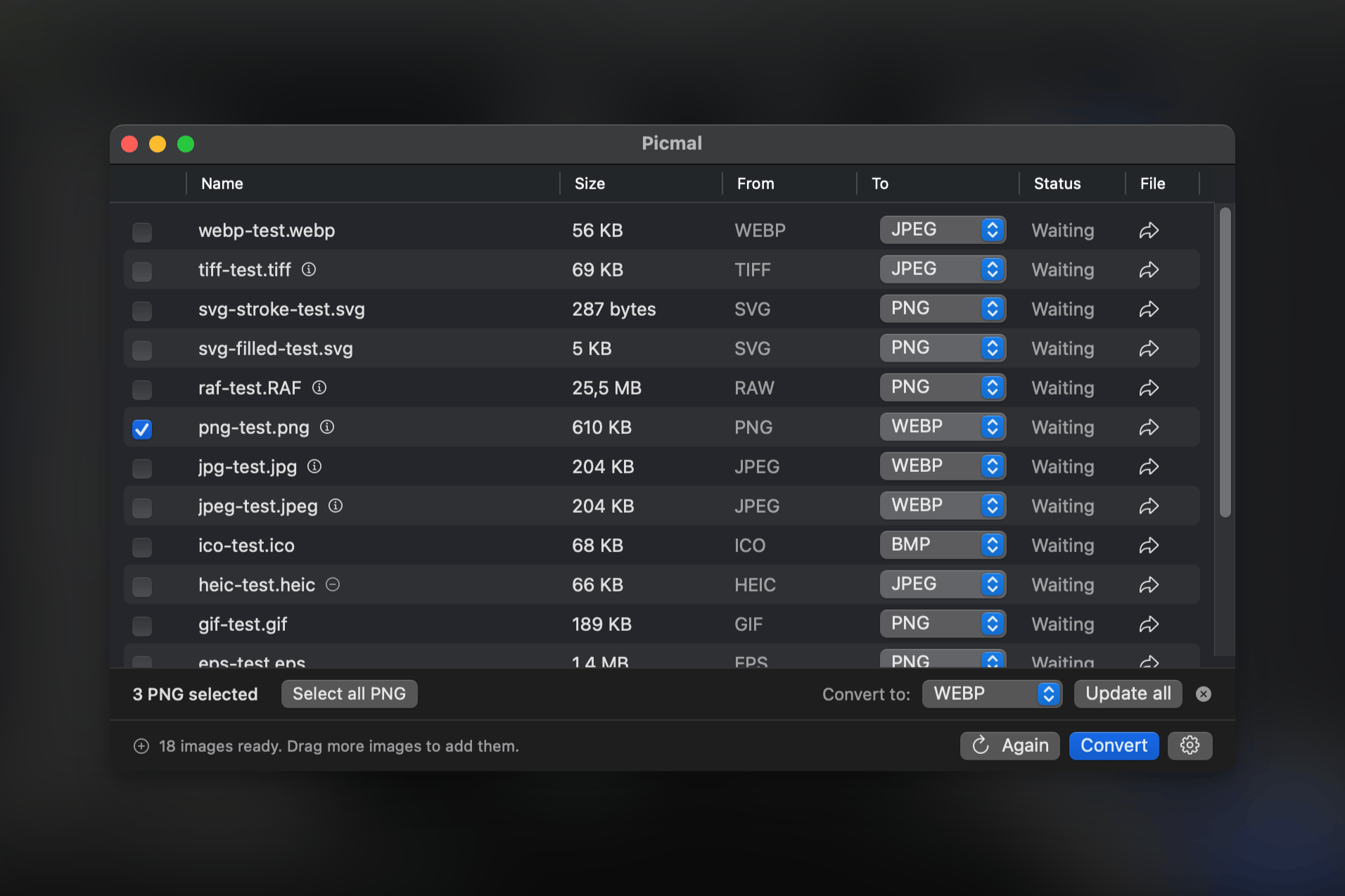
  • Fixed advanced audio settings never reaching the encoder. Setting a codec or a bitrate by hand in Audio → Advanced did nothing at all; the values were dropped on the way to FFmpeg. Video’s Advanced settings always worked, and Audio works the same way now.
  • Fixed Cancel followed by a re-run starting two batches. Pressing Convert straight after Cancel could start a second batch on top of the first one still winding down. Picmal also no longer mistakes a real failure for a cancellation because the file’s path happens to contain the word.
  • Fixed the menu bar breaking when the window is closed. Quitting from the menu-bar icon used to switch off “Keep in menu bar”, so the icon was gone at the next launch. The clipboard switch in that menu did nothing unless the main window happened to be open. Check for Updates… is reachable in menu-bar-only mode now, and the update banner in the sidebar can be dismissed.
  • Fixed the clipboard overlay leaving files behind. Every optimized image left a file in your Caches folder. The “Copied” panel also stayed open for two seconds even when you’d set dismissal to Never, failures now wait for you instead of fading, and an image that was too large or in a format Picmal doesn’t handle says so instead of nothing happening.
  • Fixed dropping the same folder twice duplicating every row. The copies raced each other for the same output file. A second drop also no longer throws away what the first one found.
  • Fixed scheduled runs going missing. A job whose files had moved was dropped from the schedule instead of being put back, firing a schedule replaced your file list rather than adding to it, and a time typed on the current minute could land in the past.
  • Fixed Vectorize tracing the same file twice. Running it again produced logo 2.svg next to the logo.svg it made the first time. Setting a style on one row also used to overwrite the style set for all rows, and the “all rows” value is remembered between launches now.
  • Fixed the custom DPI field forgetting what you typed. It came back empty when you reopened Settings, and it applied the number as you typed rather than when you finished.
  • Fixed Show in Finder after a Convert batch from the menu bar. It looked for the output paths before Picmal had written them down.
  • Fixed the About and Watched Folders tabs looking lighter than the rest of Settings in Light mode.
  • Fixed a failed chapter split leaving files behind. Splitting an audiobook that broke halfway left the chapters it had already written on disk with nothing to tell you they were there.
  • Fixed the window freezing when your Mac runs out of memory. When memory gets critically low, Picmal frees its caches. That cleanup did its bookkeeping on the main thread, right when everything was already crawling, and could hang the window for a couple of seconds. It runs in the background now.
  • Fixed wide-gamut photos losing their colors. Converting an Adobe RGB or Display P3 image to WebP came out oversaturated, greens especially. Picmal removed the color profile but left the pixel values alone, so browsers read them as sRGB. Convert and Compress translate those images to sRGB before the profile goes now, and if you keep metadata the profile is written into the output instead.
v1.8.6 Download

Settings changes take effect, every time

A small release that closes a frustrating gap: changing a setting after a run could quietly do nothing. Pick a different preset, hit run again, get the same files back. Both of those paths now do what you asked.

Bug fixes

  • Fixed a quality preset change doing nothing after a run. Picking a different preset or moving a slider left your files marked as done, so the next run silently skipped them. They now go back to waiting, and a re-run uses the new settings. Settings also spells out where presets apply: the Compress tool, and Convert only when “Compress while converting” is on.
  • Fixed picking a video codec in Compress not changing the codec. Compressing a VP9 video with H.264 selected gave you back a file that was still VP9. The re-encode ran fine, but the safety check that stops a compressed file from growing saw the H.264 version was bigger and quietly put the original back. When you ask for a different codec, Picmal now keeps the converted file even if it’s larger — and the codec check reads the actual footage, not the embedded cover art, so videos carrying a thumbnail get the right answer too.
  • Fixed the Settings window looking dimmed in Light mode. Every tab sat on a semi-transparent gray backdrop. It’s back to a normal opaque background.
v1.8.5 Download

Scanned PDFs get much smaller, and your files can number themselves

Compressing a scanned PDF used to hit a wall: Picmal re-encoded the pictures inside it but never made them any smaller, so a big scan stayed big. It now lowers their resolution to match the quality you picked, and a 25 MB scan comes out around 2 MB — with every word still real, selectable text. Alongside that, filename patterns can number a batch for you, and the command line can rename files as it converts them.

New features

  • Number your files while you rename them. Filename patterns gain a {sequence} token, so a batch comes out as holiday-001.jpg, holiday-002.jpg, and so on. Use {sequence:3} to pad to three digits, or {sequence:3+10} to start counting at 010. A watched folder keeps its own running count as files arrive, and its settings show you how far it has got and let you set it back to one. See output and naming.
  • picmal-cli renames the files it converts. convert and compress take a new --pattern option that understands the same tokens as the app — {original}, {date}, {camera}, {sequence}, and the rest — so you can rename and convert a whole folder in a single command. See the CLI reference.

Improvements

  • PDF compression goes much further on scans and newspaper pages. A scanned document could only be squeezed so far, because Picmal re-encoded the pictures inside it at their original size and never made them smaller. It now lowers their resolution to match the quality you picked, so a 25 MB scan lands around 2 MB instead of 10 MB, and the text stays real text you can select and search. Pages that are mostly text are left alone, just as before. See PDF tools.
  • Picmal tells you when links and bookmarks are removed. Squeezing a PDF that hard means rebuilding it, and a rebuilt PDF loses its links, bookmarks, and form fields. When that happens, the row shows a warning saying so, and picmal-cli prints the same warning and marks the file pdf_structure_dropped in its JSON output. Documents with none of those — scans, photo exports — compress with no warning at all.
  • Compressing a track keeps its album art. Compression used to rebuild the file without the artwork, so a compressed MP3 or M4A turned up blank in Music and on your phone. The art now survives, and a cover image sitting in the source folder gets embedded when you compress too, not just when you convert. Turning on “Remove metadata” still strips it.
  • Picmal tells you when cover art can’t be attached. Only MP3, M4A, M4B, ALAC, and FLAC can carry a picture. Picking WAV, AIFF, OGG, or Opus with cover art turned on used to drop the image without a word; now the row shows a warning explaining why.
  • macOS says why Picmal is asking for a folder. The prompts for your Desktop, a network drive, or your Music library gave you one vague line to make a decision on. Each one now tells you what Picmal reads, what it writes, and where.

Bug fixes

  • Fixed a compressed PDF coming out bigger than it went in. The DPI setting tags photos, and a PDF has no such tag to write — but turning it on quietly switched off the check that stops a compressed file from growing. PDFs are now left out of it.
v1.8.4 Download

SVG conversion actually works, plus stability fixes

No new tools this time, just things working the way they should. Converting to SVG had been silently broken since the option was added, and a handful of edge cases — mislabeled PDFs, videos with embedded artwork, read-only disks, and Finder’s “Open With” — could crash the app or behave strangely. All fixed.

Improvements

  • Converting to SVG now gives you an SVG. Picking SVG as the output format failed every time, because the tracer it needed had never been bundled. Convert now uses the same tracer as the Vectorize tool, so a PNG or JPG comes out as real vector paths you can open in Illustrator or Affinity.
  • Picmal won’t quietly replace a file that’s already there. If something with the output name already sits next to your file, the new one is saved alongside it as photo_converted 2.jpg instead of overwriting what was there. See output and naming.

Bug fixes

  • Fixed a crash on files that aren’t really PDFs. A renamed image or a half-downloaded document could take the whole app down instead of failing quietly, whether it went through PDF compression, PDF conversion, an Illustrator file, or the command line. Picmal now checks the file before it opens it.
  • Videos with cover art convert and compress again. A clip carrying embedded artwork — GoPro footage, anything downloaded with a thumbnail — had the artwork encoded as the video while the real footage was thrown away, and the file failed outright. Picmal now picks the actual video track.
  • A straight answer when the disk is read-only. Saving next to a file on a locked disk image or a camera card failed with “Processing failed unexpectedly,” and could even ask for folder permission that would never have helped. It now tells you the disk is read-only.
  • “Open With → Picmal” opens one window, not a window per file. Sending a few files from the Finder spawned a separate window for each one, and on newer versions of macOS the window could stay buried until you clicked the app. All the files now land in one window, and that window comes to the front.
v1.8.3 Download

Photos into a slideshow, and PDF compression that keeps your text

Two big changes this release. There’s a new Slideshow tool that turns a folder of photos into a video, and PDF compression has been rebuilt from scratch — it now shrinks the images inside a PDF instead of flattening every page into a picture, so your text stays selectable. Under the hood, both the PDF and video engines were rebuilt, which made the app about 100 MB smaller.

New features

  • Turn photos into a video slideshow. The new Slideshow tool takes a batch of images — mixed sizes, HEICs, whatever — and builds an MP4. Choose how long each image stays on screen and the frame size: 4K, 1080p, 720p, or match your largest photo. Every image is scaled to fit and centered, so nothing gets cropped. Also available as picmal-cli slideshow. See Video tools.
  • PDF compression that keeps your text. Compressing a PDF used to redraw every page as a flat photo — selectable text, links and crisp vector graphics all gone — and on text-heavy documents the “compressed” file often came out larger, so Picmal quietly kept the original and told you nothing. The compressor now re-encodes only the images inside the PDF and leaves everything else untouched. A web article saved as PDF typically shrinks 60–80%, and every word stays selectable. Scanned documents are still compressed page by page, now at a resolution that never upsamples. See How PDF compression works.
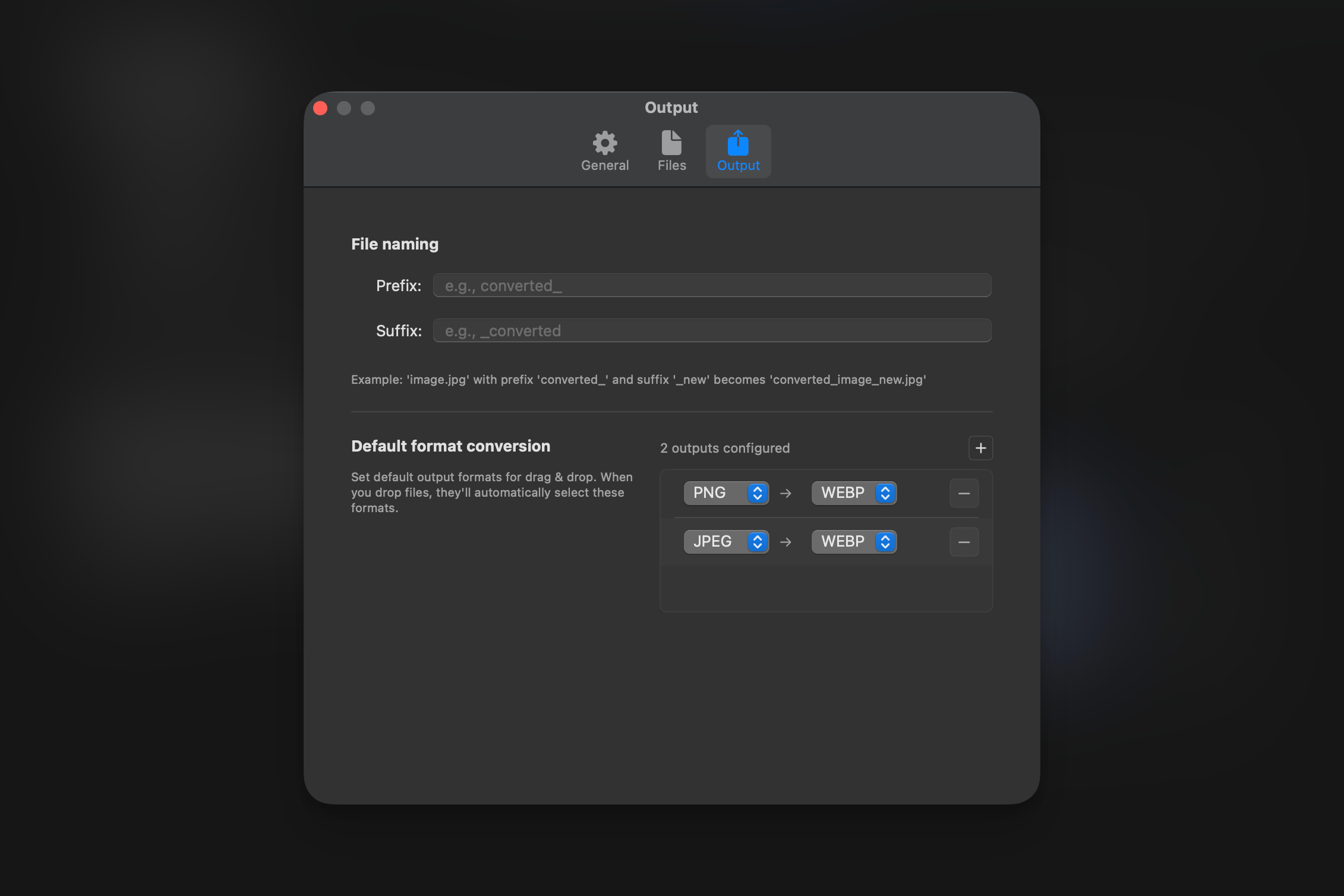
  • Tell Picmal to leave a format alone. Default output formats gain a KEEP option: map HEIC to WebP but keep your PNGs as they are, and drop a whole mixed folder without sorting it first. Kept files land in the list but are never converted. Compressing is unaffected. See Default format conversion.
  • “Already optimized”, said out loud. When compressing can’t make a file smaller, the Saving column now tells you the original was kept instead of showing a silent dash. No more wondering whether anything happened.

Improvements

  • Video conversion runs on your Mac’s media engine. H.264 and HEVC now always encode through Apple’s hardware encoder — faster, easier on the battery, and no longer limited to Apple Silicon. The rebuilt video engine is also 55 MB smaller.
  • The app is 47 MB lighter from the PDF side too. PDF and Illustrator files are now handled natively with Apple’s own frameworks, so the bundled Ghostscript engine is gone. AI files render sharper through their PDF layer, and AI → PDF now stays true vector instead of being rasterized.
  • Settings looks right in light mode. Sections and the tab bar used to blend into a white background; they now stand out from a gray backdrop, matching what dark mode always did.
  • The PDF quality slider works across its whole range. Below 65 it previously changed nothing; every step now maps to a distinct output.

Bug fixes

  • Fixed picmal-cli compress failing on PDFs. It previously refused every PDF with a cryptic ImageMagick error. It now uses the same text-preserving engine as the app, and never writes a file larger than the input.

Removed

  • EPS input. EPS is PostScript, which macOS itself can no longer read, and supporting it was the only reason the Ghostscript interpreter was in the app at all. If you have EPS files, export them as PDF from Illustrator or Affinity Designer and Picmal will take it from there. Illustrator (.ai) files are unaffected.
v1.8.2 Download

One output format for the whole drop

Until now, telling Picmal what to convert to meant writing a rule per input format. This release adds a single switch: pick one output format and everything you drop comes out as that. The app icon has been redrawn too.

New features

  • Convert everything you drop to one format. In Settings → Output → Default format conversion, switch from Per input format to Convert everything to and pick a format. A folder of mixed JPGs, PNGs and HEICs all come out as WebP, no rule-writing required. Audio and video are left alone. See Output and naming.

Improvements

  • A fresh app icon. The app icon and the menu bar icon have been redrawn to sit properly alongside the rest of your Mac.
  • A file can now convert to the format it already is. WebP was never offered as a target for a WebP file, so sending a mixed folder to WebP pushed those files out to PNG or JPG — and the batch grew instead of shrinking. Any image format can now target itself, and Picmal re-encodes it at your compression quality instead. See Same-format conversions.

Bug fixes

  • Fixed picmal-cli destroying a file it converted in place. Converting a file to the format it already was, with --overwrite, handed the encoder the same path to read from and write to at once, and the original was lost. It now writes a copy alongside and swaps the finished file in.
v1.8.1 Download

Convert Apple icon files, and leaner WebP

Picmal has made app icons for a while — now it reads them back. Drop an .icns in and you get every size it holds as a separate image. This release also fixes a big one: converting to WebP could leave you with a larger file than you started with.

New features

  • Convert Apple icon files. Drop an .icns in and turn it into PNG, JPG, or whatever else you need. An icon file holds several sizes at once, so each one becomes its own file saved next to the original — icon-1024x1024.png, icon-512x512.png, and so on. Works in the app and from the terminal with picmal-cli convert. See Converting files.

Bug fixes

  • Fixed WebP conversions bloating the file. With compression turned off, Picmal was encoding WebP — along with AVIF, HEIC, and other lossy formats — at full quality, so a 355 KB JPEG could balloon past 1 MB. It now converts at a visually lossless quality that stays well under the original. Same fix for clipboard optimization.
  • Fixed the Saving percentage getting stuck at 0%. Re-running a file with Again, or switching its output format, could leave the Saving column reading 0% even when the file did get smaller. It now compares against your original file every time.
v1.8.0 Download

Vectorize images and lift out backgrounds

Two new tools land in the sidebar this release. Vectorize traces a PNG or JPG into a real SVG — actual paths, not a bitmap in disguise — and Remove Background lifts the subject out of a photo onto a transparent PNG. Both run entirely on your Mac, nothing gets uploaded, and both handle a whole batch at once.

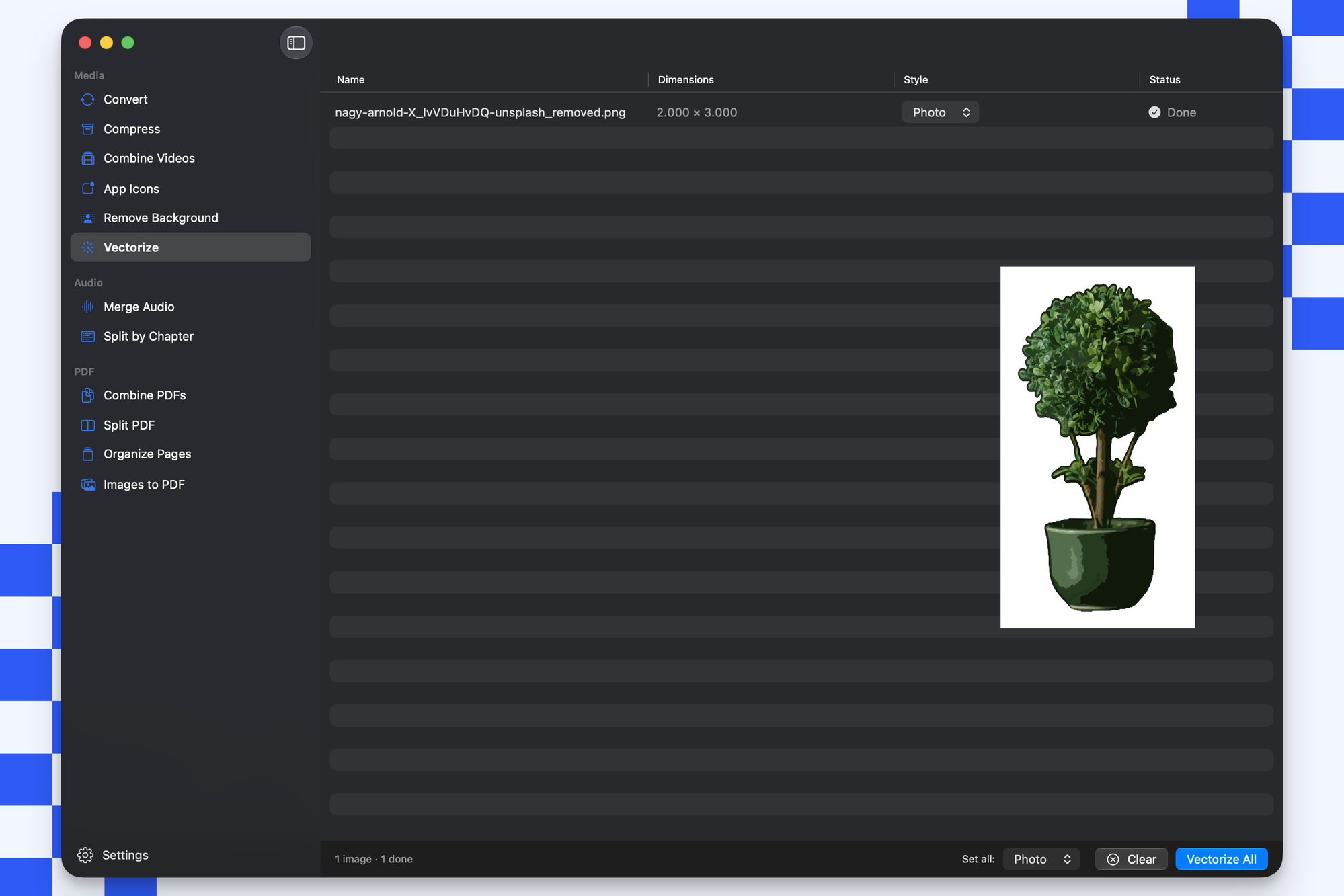
Picmal's Vectorize tool with a potted plant traced into a crisp SVG in Photo style, showing the per-row Style dropdown and the Vectorize All button

New features

  • Vectorize turns images into real SVG vectors. Drop a batch of PNGs, JPGs, GIFs, or WebPs, pick a style per image — Logo, Photo, or B&W — and trace them all at once. You get true traced paths, not a bitmap wrapped in an SVG, so it shines on logos, icons, and flat art. See Vectorize.
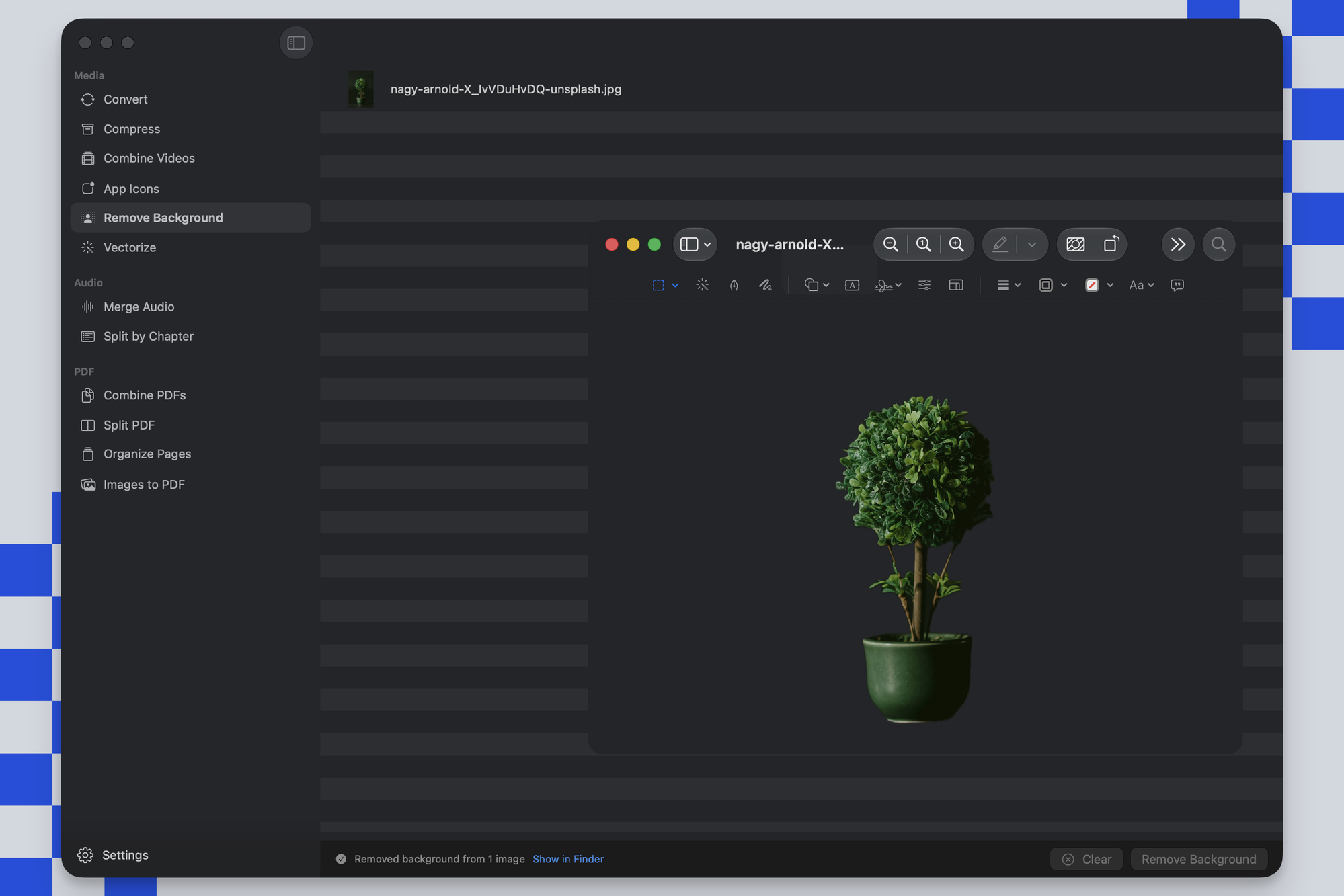
  • Remove Background cuts the subject out onto a transparent PNG. Drop an image and Picmal finds the foreground and drops the rest to transparent — all on-device, nothing uploaded. It works in the app, in Shortcuts, and from the terminal with picmal-cli remove-background. See Remove Background.

The same potted plant with its background removed, previewed on a transparent checkerboard

Improvements

  • Convert-with-compression makes smaller files. When you convert with compression turned on, Picmal now runs the same optimized encoders it uses in Compress mode, so JPEGs, PNGs, and GIFs come out smaller. Formats like BMP, JP2, and JXL that used to pass through untouched now get compressed too. See Converting files.

Bug fixes

  • Fixed a crash when converting a damaged HEIC photo. A corrupt or truncated HEIC in a big batch could take the whole app down partway through. Now Picmal skips the bad file, marks it as failed, and finishes the rest of the batch.
v1.7.9 Download

Cap video resolution, and round your app icons

Big videos can now come out smaller by resolution, not just codec: a new Resolution setting downscales 4K footage to 1080p or 720p on the way through. And the App Icons tool can round your image into a proper macOS tile instead of filling the square edge to edge.

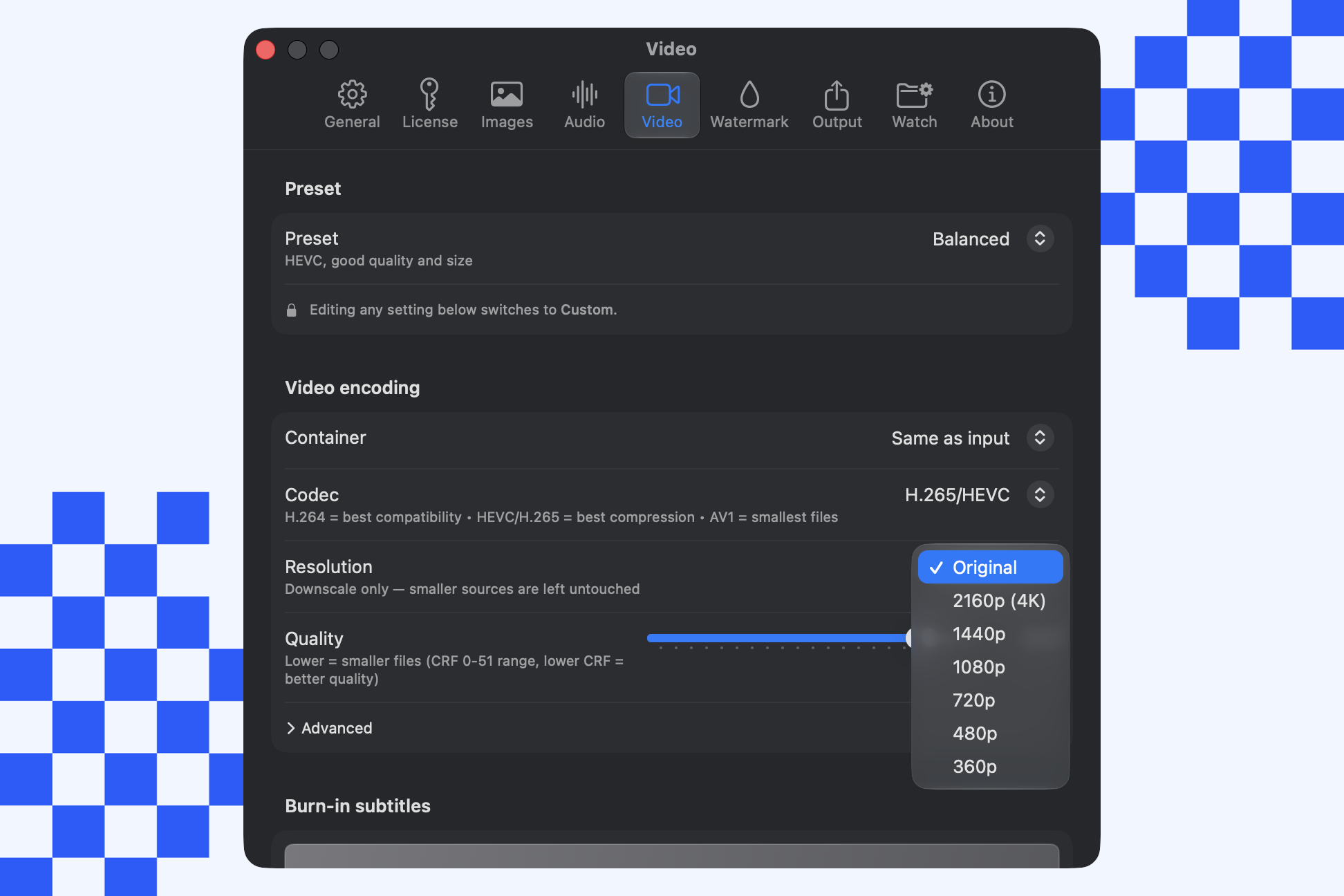
The Video settings in Picmal with the Resolution dropdown open, showing Original, 2160p (4K), 1440p, 1080p, 720p, 480p, and 360p

New features

  • Cap a video to a resolution. Video Options gains a Resolution setting — 2160p (4K), 1440p, 1080p, 720p, 480p, 360p, or Original. Picmal only ever scales down and keeps the aspect ratio, so a source that’s already smaller than your pick is left untouched. Applies to both Convert and Compress. See Audio and video.

Improvements

  • App icons can take on a real macOS shape. The App Icons tool can now round your image into a proper macOS tile — a Big Sur squircle or the rounder Tahoe corner — with the margin and soft shadow baked in, instead of filling the square edge to edge. Pick the shape (or None) next to the format checkboxes; it applies to the .icns. See App Icons.
v1.7.8 Download

App Icons from a single image

The sidebar gains a new tool: App Icons. Drop in one image and Picmal hands you back ready-to-ship app icons for every platform — no export presets to fiddle with.

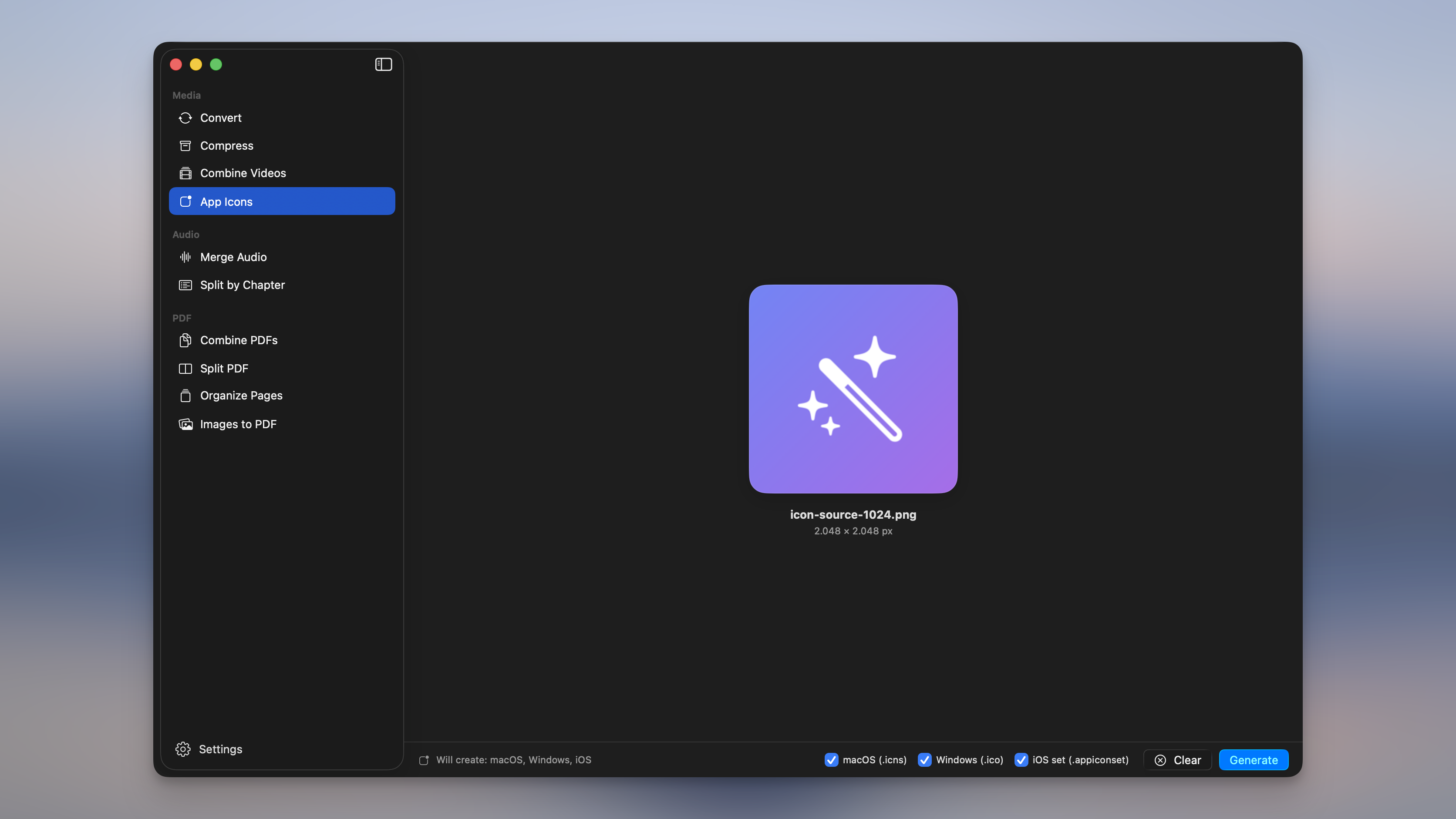
App Icons in Picmal: a 1024px source image loaded under the Media section of the sidebar, with the macOS, Windows, and iOS output formats checked in the bottom bar

New features

  • App Icons. Give Picmal a single image and it generates a macOS .icns, a Windows .ico, and an iOS icon set you can drag straight into Xcode. Pick which formats you want. A non-square image is fit into the square without cropping, and the iOS icon is flattened onto an opaque background so the App Store accepts it. Like the rest of Picmal it runs entirely on your Mac, and works from the command line (picmal-cli app-icon) and Shortcuts. See App Icons.

Improvements

  • Soft subtitles now survive compression and conversion. Videos that already carry subtitle tracks — the soft subs Subler adds, say — used to lose them every time Picmal re-encoded the file. They now come along for the ride, as long as the output format can hold them: text subtitles into MP4, MOV, and WebM, and anything into MKV. A subtitle the target format can’t store is quietly dropped so the conversion still goes through. Works in the app and from the command line.
  • A self-serve portal for your license. Lost your key, or need to free up a device? The License tab now links straight to a portal that emails you a sign-in link, then lets you recover your key, move seats between machines, and manage renewals. Your license also verifies offline now, so Picmal stays activated on a flaky connection or a plane. Existing licenses carry over on their own — nothing to re-enter. See License.
v1.7.7 Download

Combine Videos, a new tool for joining clips

The sidebar’s Media section gains a new tool: Combine Videos. Drop in a few clips, put them in order, and get one video back.

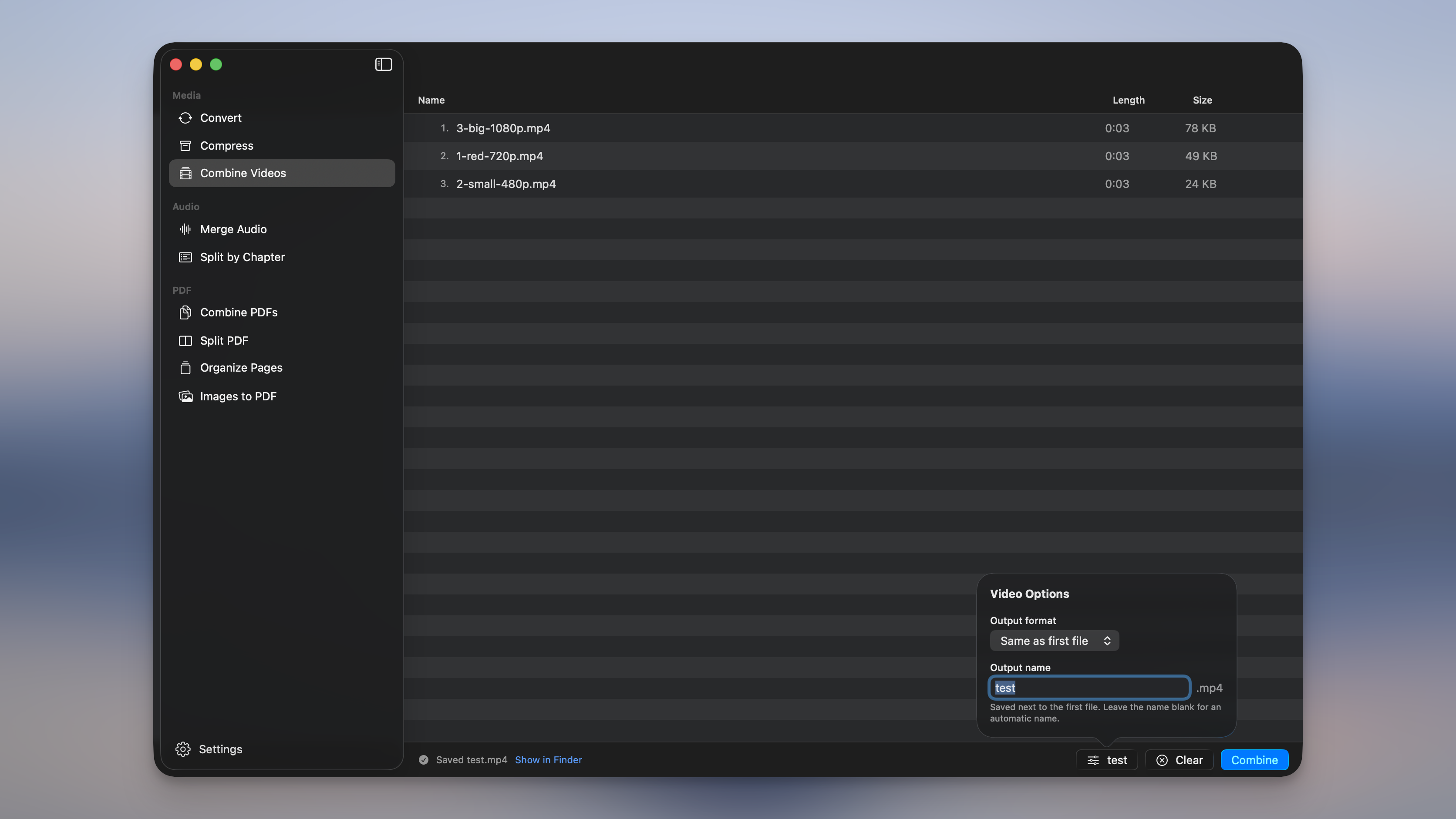
Combine Videos in Picmal: three video clips queued under the Media section of the sidebar, with the Video Options popover showing the output format and name

New features

  • Combine Videos. Drop in two or more videos, drag them into the order you want, and join them into a single file. When every clip already shares the same codec, resolution, and frame rate, Picmal copies the streams together untouched — no re-encoding, no quality loss. Mix formats or sizes and it scales each clip onto the first one’s frame and re-encodes to match. Pick the output format from Video Options, or leave it matching the first file, and name the result there too. Like the rest of Picmal it runs entirely on your Mac, and works from the command line (picmal-cli combine-videos) and Shortcuts. See Video tools.

Bug fixes

  • Fixed transparent images turning black when converted to JPEG. JPEG can’t store transparency, so a see-through PNG (or WebP, GIF, HEIC…) used to fill its transparent areas with black. They now fill with white, matching how Picmal already handled PDF. Works in the app and from the command line.
v1.7.6 Download

Audiobooks: convert, split, and build M4B files with chapters

Picmal’s Audio tools grow up around audiobooks. You can convert M4B files while keeping their chapters and cover art, break a long book into one file per chapter, and turn a folder of loose tracks into a single audiobook that scrubs by chapter in Books, Music, or QuickTime.

New features

  • Audiobook conversion (M4B). M4B audiobooks now convert to and from M4A and MP3, both in the app and from the command line. Chapters and cover art come along for the ride — even MP3 keeps its chapter markers. See Supported formats.
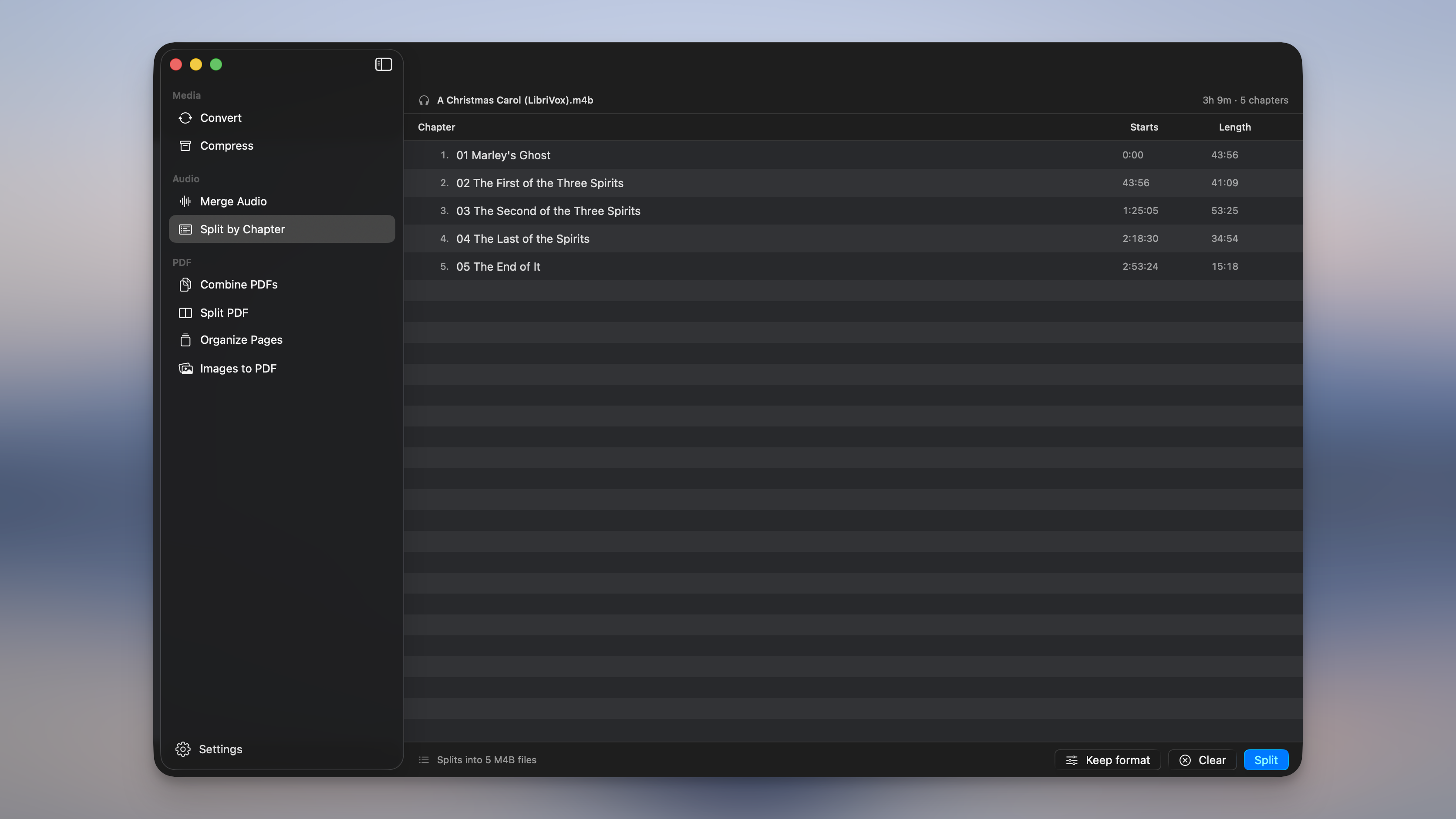
  • Split by Chapter. A new Audio tool: drop a chaptered audiobook, see its chapters listed, and break it into one file per chapter — each named Book - 01 - Chapter Title and tagged with its title and track number. Keep the original format or convert as you go. Also from the command line: picmal-cli split-chapters book.m4b --format mp3. See Audio tools and Command line.

Split by Chapter in Picmal: a chaptered audiobook's chapters listed under the Audio section of the sidebar, ready to split into one file per chapter

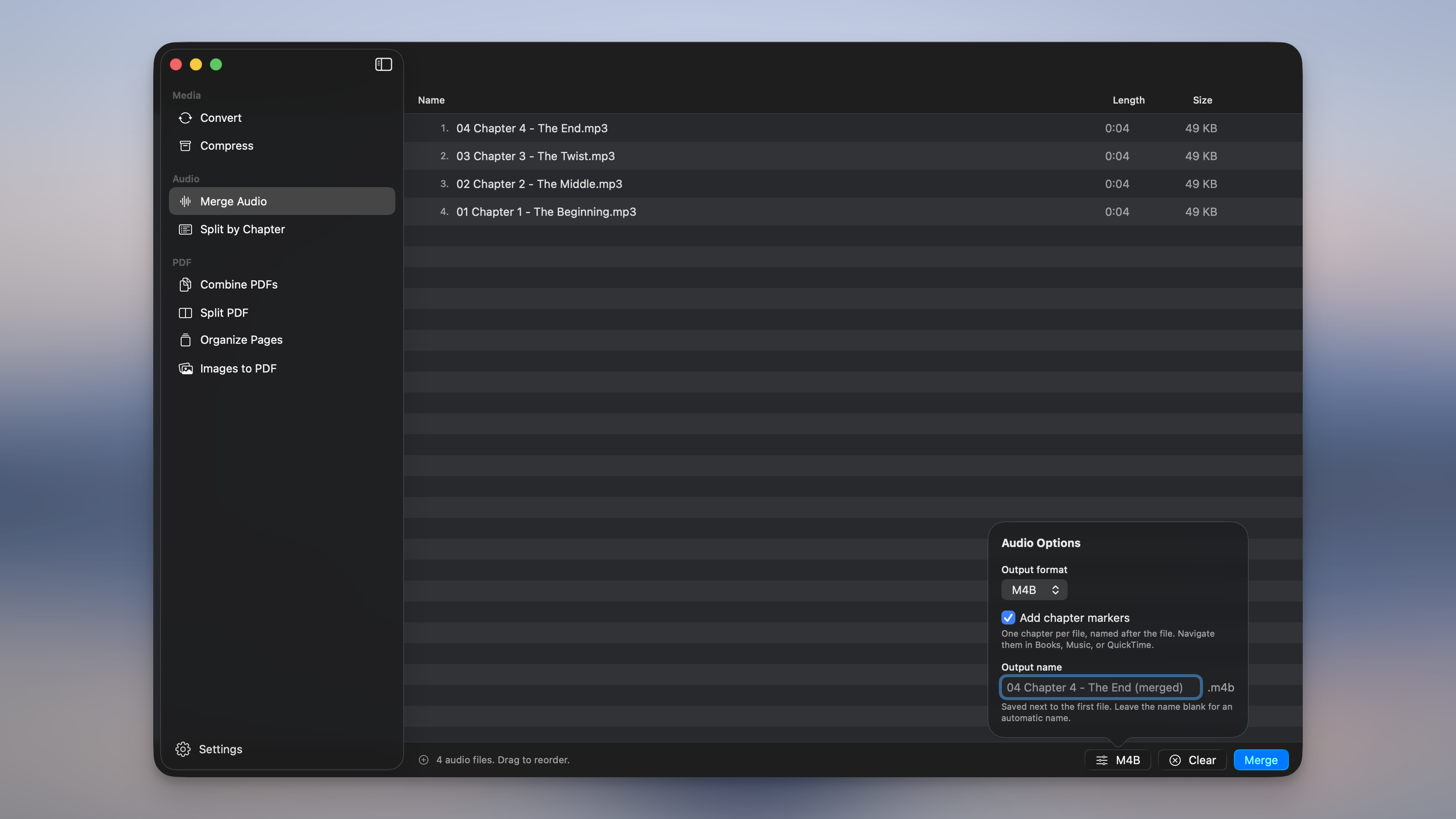
  • Merge Audio into a chaptered M4B. Merge Audio can now output M4B and turn each file you add into its own chapter, named after the file. Pick M4B in Audio Options, tick Add chapter markers, and the per-chapter files you get out of Audible or Libation become one audiobook that scrubs by chapter.

Merge Audio in Picmal building an M4B audiobook: several audio files queued with the Audio Options popover showing M4B output and the Add chapter markers option

Bug fixes

  • Fixed Picmal asking to “access data from other apps” on every launch. Your watched-folders list was stored in a shared system location that macOS treats as another app’s data. It now lives in Picmal’s own folder — the prompt is gone and your existing watched folders carry over untouched.
v1.7.5 Download

Organize PDF pages, plus grayscale and CMYK output

The PDF section gains a fourth tool for tidying up documents, and color space picks up two new targets for print and black-and-white work.

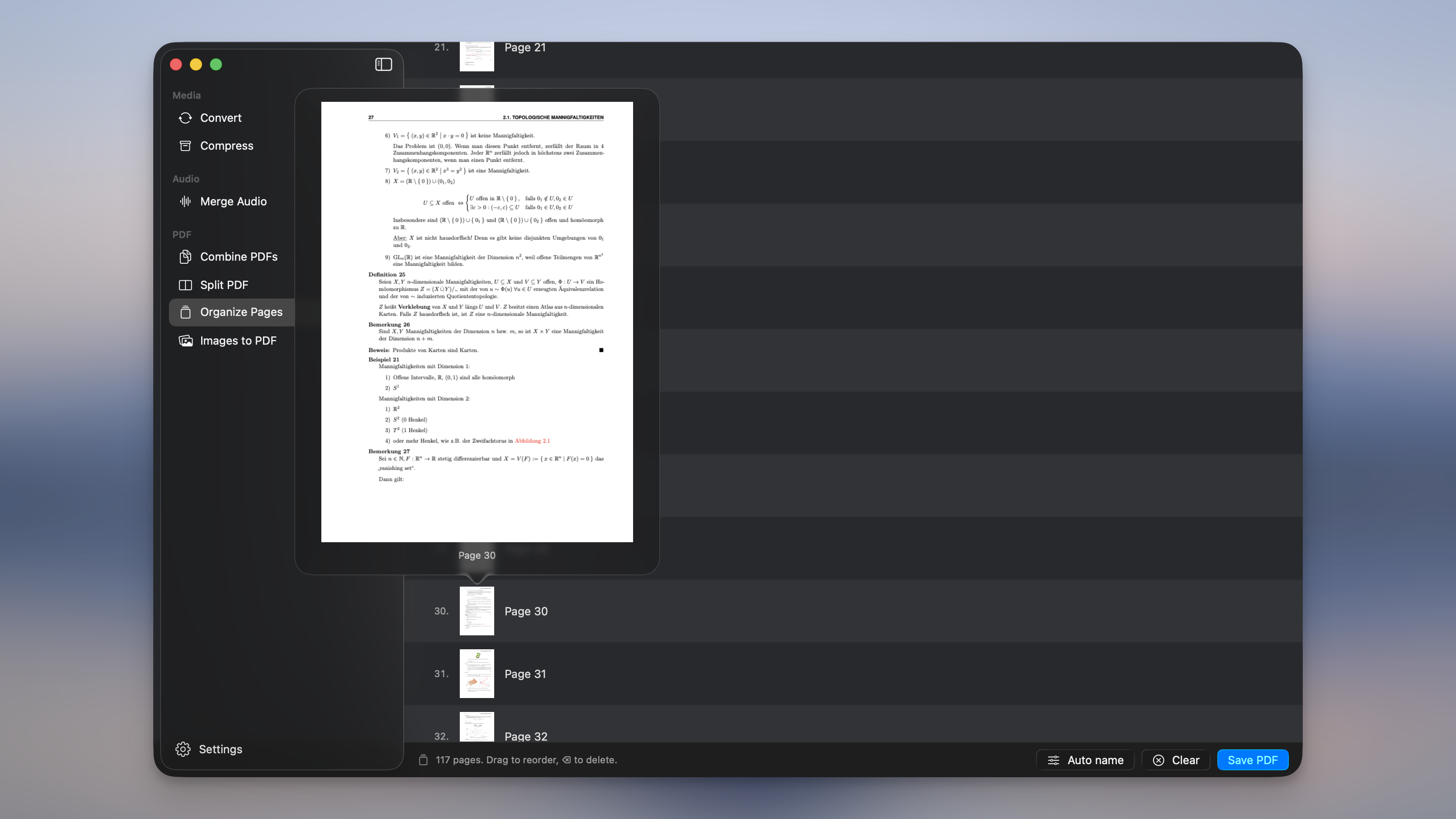
Organize Pages in Picmal: a PDF's pages listed as thumbnails under the new PDF tool, with one page hovered to show a full-size preview

New features

  • Organize Pages. A new PDF tool for reordering and deleting pages. Drop in a PDF and its pages show up as a thumbnail list — drag to reorder, delete the ones you don’t need, and click any thumbnail to preview it full-size. Save when the order looks right. App only for now. See PDF tools.
  • Grayscale and CMYK color spaces. Two new targets join the RGB profiles when you set a color space: Grayscale for clean black-and-white output, and CMYK — through Picmal’s bundled color profiles — for print-ready files. Both work in the app and from the command line (--color-space cmyk). See Command line.

Improvements

  • Hardened image and PDF processing against malicious files. ImageMagick’s security policy now blocks risky script and URL-fetching coders, and Ghostscript’s sandbox permissions are trimmed down to just what it needs. Copyright and artist metadata you set are also sanitized before they’re written to a file.

Bug fixes

  • Fixed PDF compression hanging indefinitely on complex files that produced a lot of Ghostscript warnings.
  • Fixed images and PDF pages sometimes rendering a pixel smaller than expected — scaled dimensions were truncated instead of rounded, which in rare cases could even skip a page.
  • Fixed watched folder file size filters using 1024-based kilobytes while the rest of Picmal uses 1000-based ones.
v1.7.4 Download

Merge Audio, a new tool for joining audio files

The sidebar gains an Audio section with its first tool: Merge Audio. Drop in a few tracks, put them in order, and get one file back.

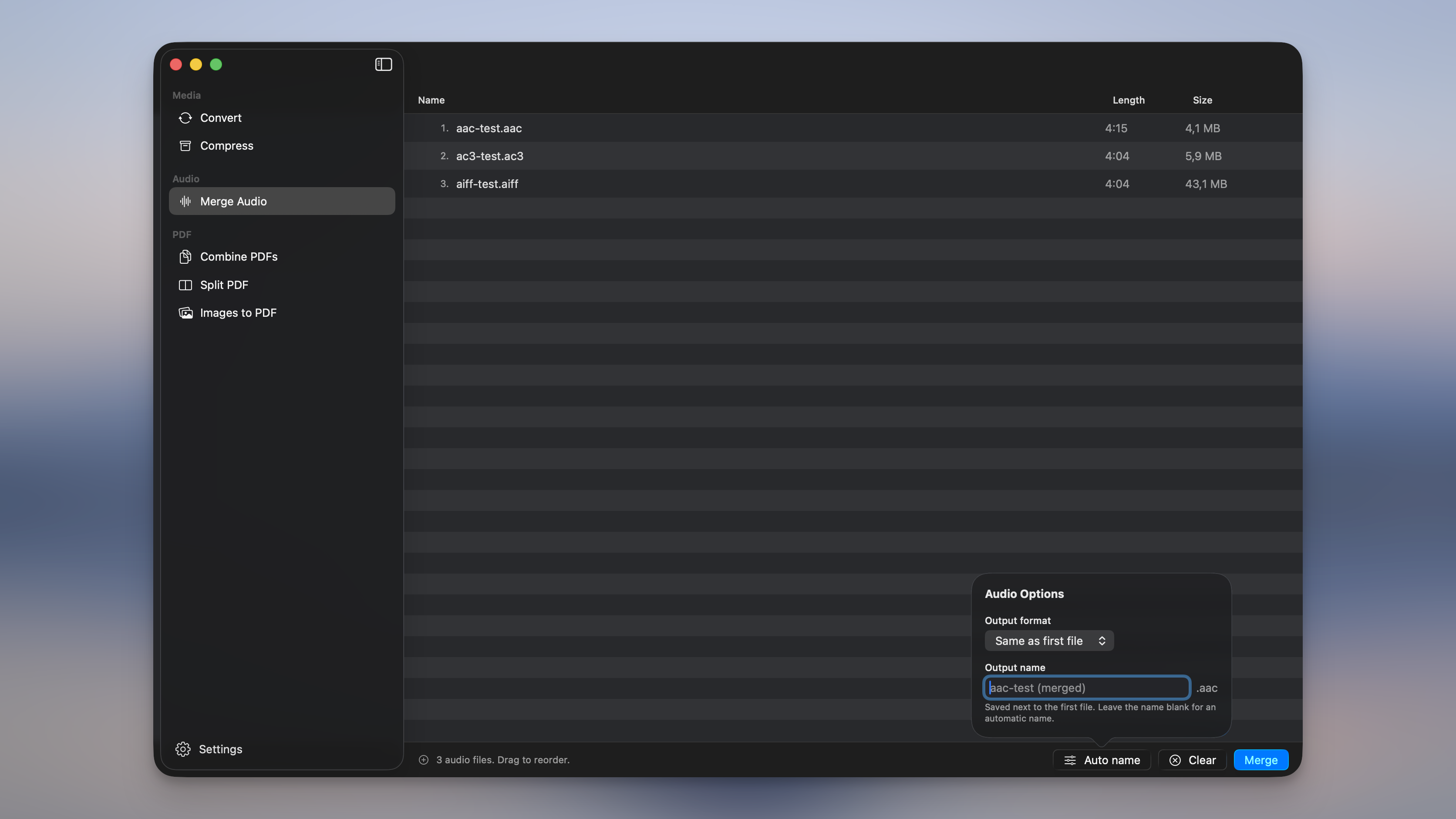
Merge Audio in Picmal: three audio files queued under the new Audio section of the sidebar, with the Audio Options popover set to output format and name

New features

  • Merge Audio. Drop in two or more audio files, drag them into the order you want, and join them into a single track. When every file already shares the same format, Picmal copies the streams together untouched — no re-encoding, no quality loss. Mix formats and it re-encodes to match. Pick the output format from Audio Options, or leave it matching the first file, and name the result there too. Like the rest of Picmal it runs entirely on your Mac, and works from the command line (picmal-cli merge-audio), Shortcuts, and Raycast. See Audio tools.

Bug fixes

  • Fixed Convert and Compress dropping extra audio tracks from videos. They kept only the single track ffmpeg picked by default, so commentary and alternate-language tracks quietly disappeared. Every audio track now carries through to the output.
v1.7.3 Download

Split PDF, plus a Shortcuts metadata fix

The PDF section gains a third tool: Split PDF. Pull one document apart into several by page range — the natural counterpart to Combine PDFs.

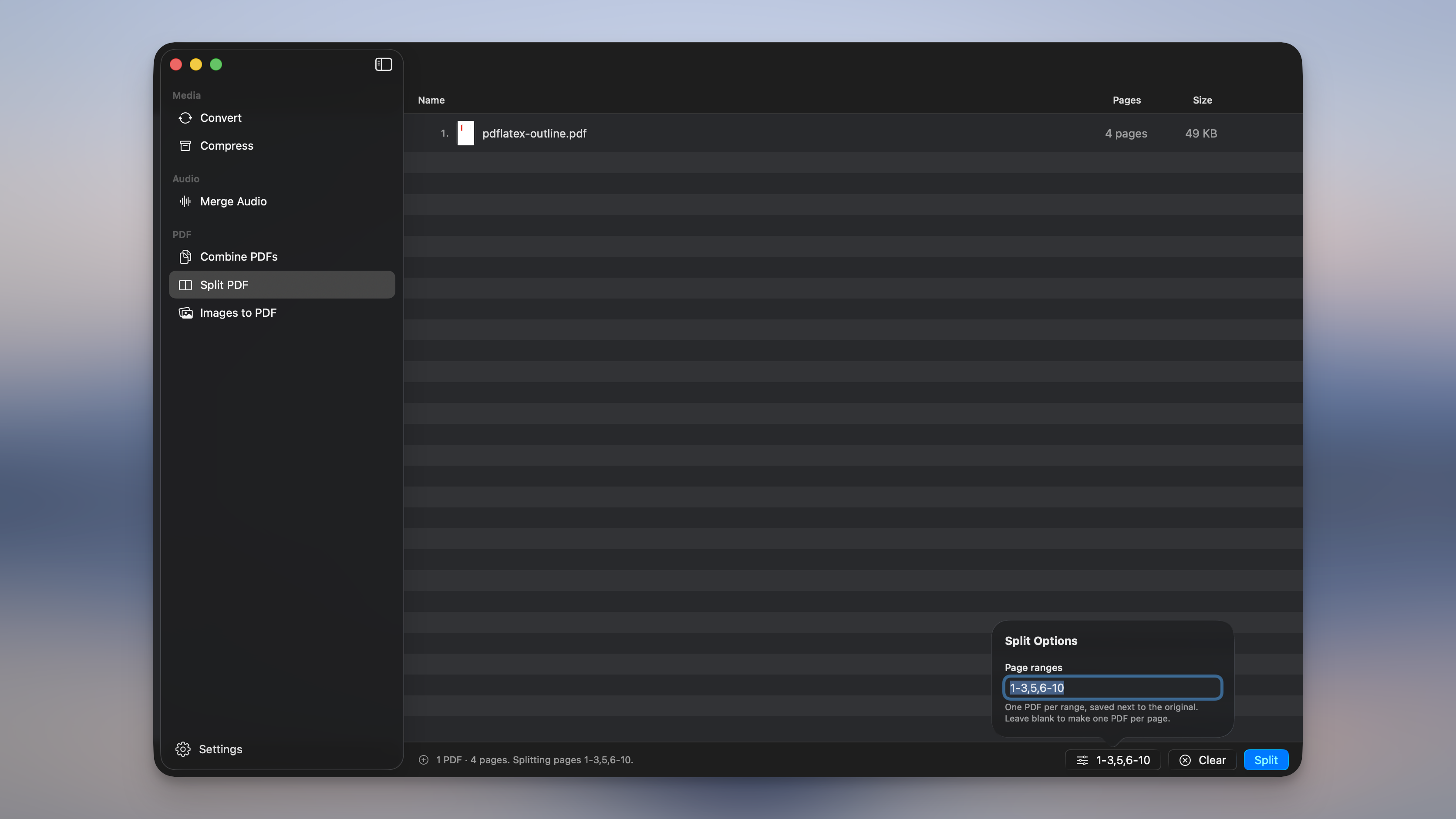
Split PDF in Picmal: a four-page PDF queued under the PDF section of the sidebar, with the Split Options popover set to the page ranges 1-3,5,6-10

New features

  • Split PDF. Drop a PDF in, type the page ranges you want — 1-3, 5, 8- — and each range becomes its own file, saved next to the original. Leave the field blank to split every page into a separate PDF. Like the other PDF tools, it runs entirely on your Mac and works from the command line (picmal-cli split-pdf), Shortcuts, and Raycast.

Bug fixes

  • Fixed the Remove Metadata option in the Compress shortcut not actually stripping metadata. The step ran but couldn’t read your settings, so it quietly did nothing — and if a file was already small enough that Picmal skipped compression, the original came back untouched, GPS and all. Both are fixed. See Integrations.
v1.7.2 Download

Stability fixes for Opus, big batches, Shortcuts, and tricky videos

A round of stability fixes across audio, video, and the Shortcuts integration — plus a couple of crash fixes that show up most on Intel Macs and in large batches.

Bug fixes

  • Fixed Opus conversions failing at high bitrates. Asking for 320 kbps always errored out because Opus tops out at 256 kbps — it now quietly clamps to 256 kbps instead of aborting.
  • Fixed a crash when many files failed at once. In large batches on Intel Macs, rapid back-to-back failures could trigger a crash. A race condition in the error reporting was to blame.
  • Fixed Remove Metadata in the Shortcuts action not actually stripping metadata. The setting was passed in correctly but dropped before it reached the step that does the work, so GPS and EXIF data stayed in the file no matter what you set. See Integrations.
  • Fixed iPhone Live Photos and other .mov files with bad timestamps failing to convert. Some videos carry timestamps that confuse the muxer part way through, aborting the conversion. Picmal now catches that and retries with the timestamps corrected.
  • Fixed a crash when an image conversion process was killed mid-read. Capturing output from a conversion process could raise an unrecoverable error if it was interrupted during a large batch — it now uses the same safe reading approach as the rest of the app.
v1.7.1 Download

Small fixes for popovers, Intel, and the title bar

A few rough edges smoothed over: a runaway popover, a misleading Intel error message, and a file list that crept into the title bar.

Bug fixes

  • Fixed the error detail popover ballooning to full screen. On wide displays it could stretch to fill the window — it now wraps at a comfortable width.
  • Fixed Intel tool-launch failures showing up as a misleading “path issue”. A dynamic library error, common on Intel or under Rosetta, was getting swept into a generic message. You now see the real error instead.
  • Fixed the file list bleeding into the title bar on macOS 15. Rows could scroll up behind the traffic-light buttons — the title bar area now stays clean and matches the list.
v1.7.0 Download

Faster video, tighter compression

Changing a video’s container is now near-instant, mixed batches move faster, and PNG, WebP, and AVIF all squeeze out a few extra percent.

Improvements

  • Container swaps are near-instant. Switching a video’s container while keeping the same codec — MOV to MP4, MP4 to MKV, and so on — now copies the stream straight across instead of re-encoding it. Even with a video preset active, a 5-second clip finishes in well under a second instead of 20-plus.
  • Mixed image and video batches are faster. When images and videos run side by side, image jobs now leave a couple of CPU cores free for video. Before, the image pool grabbed everything and video conversions slowed to a crawl.
  • Tighter PNG compression at Max Compression. Level 9 now runs Zopfli on smaller files — a slower but stronger compressor that finds a few extra percent without touching quality.
  • WebP works harder on bigger files. Picmal runs two encodes and keeps whichever comes out smaller. That now covers files up to 10 MB, up from 4 MB.
  • Smaller AVIF at aggressive quality settings. Pick a low quality preset and the encoder digs in a little harder, shaving a few percent off without any visible change.

Bug fixes

  • Fixed a target frame rate above the source inflating the file. Picmal was duplicating frames to hit the target, which made files bigger and encodes slower for no visual gain. The target now only kicks in when it actually lowers the rate — set 48 fps on a 25 fps clip and the output stays at 25.
  • Fixed the “Saving” estimate showing in plain Convert mode. It was sample-encoding video behind the scenes even when nothing would be compressed, then showing a misleading saving percentage in the file list. It now only runs in Compress mode or when “Compress after convert” is on.
v1.6.9 Download

Clearer statuses and light-mode fixes

A handful of fixes to make Picmal’s status labels honest and to clean up some light-mode rough edges on macOS 26.

Improvements

  • Unsupported formats now say “Not supported.” Files that can’t be compressed — like RAW or DNG — used to land in the same red “Failed” state as a real error, complete with an error popover. Now they show a plain “Not supported,” so it’s clear this is a format limitation, not something that went wrong.
  • Re-added output files now say “Skipped.” Drop in a folder that already holds compressed files from an earlier run and those files get picked up as inputs. They used to sit on “Waiting” doing nothing, with no explanation. Now they show “Skipped,” with a tooltip telling you another file in the batch is already writing to that name.
  • A roomier schedule sheet. It’s a little wider with more breathing room, so the text wraps less awkwardly.

Bug fixes

  • Fixed the bottom-bar buttons disappearing in light mode on macOS 26. Clear, Again, Cancel, and Convert/Compress all vanished against the light toolbar — a tint override was rendering the Liquid Glass look invisible on light backgrounds.
  • Fixed the format picker vanishing when you selected a row. Clicking a file in the list turned the format picker into a blank white box, because the text was rendering white-on-white over the blue selection. The label now stays legible whether the row is selected or not.
v1.6.8 Download

A new sidebar, Combine PDFs, and Images to PDF

Picmal has a new sidebar. Convert and Compress now live under Media, and a new PDF section adds two tools for working with documents — all still running entirely on your Mac.

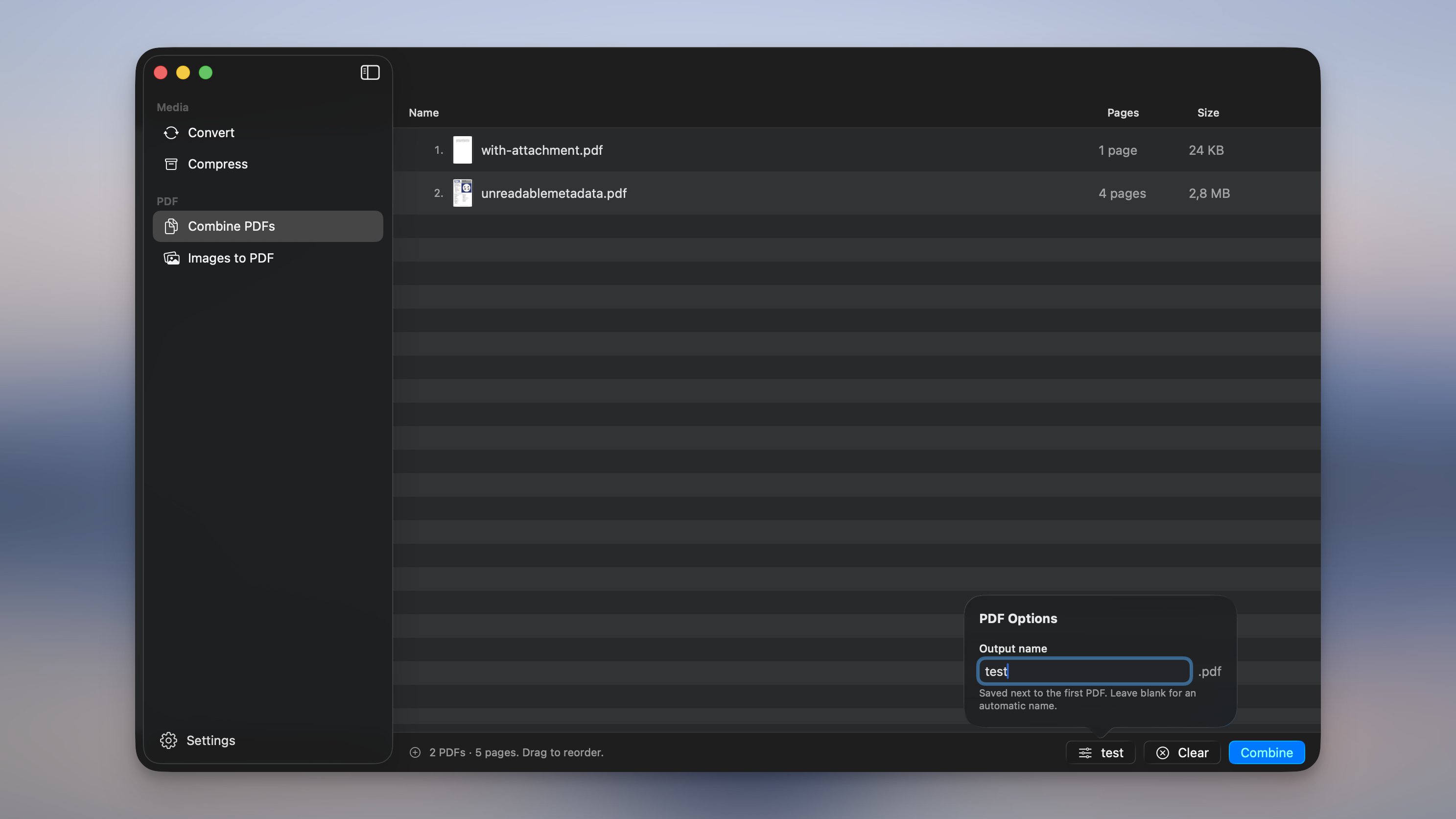
Picmal's new sidebar with Media and PDF sections, showing Combine PDFs with two documents queued and the PDF Options popover naming the output file

New features

  • A redesigned sidebar. Picmal’s tools moved to the side, grouped into Media (Convert, Compress) and PDF (Combine PDFs, Images to PDF), with Settings at the bottom and the title bar gone — so there’s room to grow beyond converting and compressing.
  • Combine PDFs. Drop in several PDFs, drag to reorder them, and merge everything into one document. Name the output in PDF Options or leave it blank for an automatic name. The combined PDF is saved next to the first file and never overwrites anything.
  • Images to PDF. Turn a batch of images into a single PDF, one image per page. Drag to set the page order, pick a page size (Fit to Image, A4, US Letter, or a custom size in millimeters), set the image quality, add an optional password, and name the output file. Sideways phone photos come out upright.
  • PDF tools work everywhere. Both run from the Finder right-click menu, the Shortcuts app, and the command line (picmal-cli combine and picmal-cli images-to-pdf). You get a notification when the PDF is ready, just like Convert and Compress.
  • Custom metadata control. On top of strip-all, keep-essential, and keep-all, a new Custom mode lets you choose exactly which categories to keep — location (GPS), camera & exposure, date & time, copyright & author, color profile, orientation, serial & owner IDs, and the embedded thumbnail — each on its own. The command line gains matching --keep and --strip flags.

Improvements

  • A fresh coat of Liquid Glass. The bottom bar, the clipboard overlay, and the license banner now use macOS’s Liquid Glass look, so they sit more naturally over whatever’s behind them.
  • Combining PDFs now reports a clear error if a page can’t be read, instead of quietly leaving it out of the merged file.

Bug fixes

  • Fixed resizing and compressing in one go producing bloated files. When an image was both resized and compressed — in Compress mode or a watched folder — the resize step quietly undid the optimization. The output is now optimized properly, matching a separate resize-then-compress pass.
  • Fixed converted photos coming out sideways. Portrait shots from your iPhone (and any photo that relies on a rotation tag) were being flipped to landscape on convert. Picmal now rotates the pixels upright, the Orientation setting in Settings → Images does what it says, and the command line rotates correctly too.
  • Fixed conversions and compressions that could freeze or stall. A quick one-off job could hang right as it finished, and big batches could get stuck partway. The heavy PDF, SVG, and image work now runs to the side, so the app stays responsive and files keep moving.
  • Fixed some audio failing to convert to OGG. Converting to OGG (Vorbis) could fail with an “encoder setup failed” error, most often on lower-sample-rate files like 22 kHz MP3s. Picmal now sets the Vorbis quality directly instead of a target bitrate, so these conversions go through.
  • Fixed a crash when removing files with the Delete key. Deleting selected rows from the keyboard while the list was updating could bring the app down. Deletions now wait for the list to settle, the same way the right-click Remove already did.
v1.6.7 Download

A steadier file list and a clearer video speed control

Fixed a crash that could strike mid-run when the file list was busy reshuffling itself. Rows now hold their place while they process and only move when a file finishes or you change its priority, so a big batch stays steady on screen instead of jumping around underneath you.

The video speed control is clearer too. Custom speed now takes a plain multiplier (type 5 for 5×, up to 8×) instead of a confusing percentage. And the Delete key now edits the speed field properly rather than removing the file from the list.

We also fixed a rare crash inside Picmal’s own crash reporting, where tidying up an error report could itself bring the app down instead of just quietly logging it. Alongside that, we updated the crash-reporting library and brought the command line tool in line with the app, so both report problems the same way under the hood.

v1.6.5 Download

Faster video conversion and more reliable Finder actions

Video conversion and compression are faster, especially on powerful Macs with lots of cores. Picmal now runs a few video encodes side by side instead of starving them all, gives each one a proper share of the CPU, and AV1 output is 20–40× quicker. Watched-folder and clipboard jobs run quietly in the background so they don’t slow down whatever you’re doing.

The Finder right-click Convert and Compress options now run reliably even when Picmal is closed. They process quietly in the background without pulling focus from Finder, with a notification showing what Picmal is working on and the progress as it goes (so a long file doesn’t look stuck), honour your “Save to subfolder” setting, and let you know when a selection has nothing Picmal can convert instead of just flashing open and closing. The Services menu items are now grouped together as “Picmal — Add Files”, “Picmal — Convert” and “Picmal — Compress”.

v1.6.4 Download

New audio and video formats to convert to and from

Two new audio formats you can convert to and compress: EAC3 (Dolby Digital Plus) and MKA (Matroska audio). You can also open many more audio files to convert from — Monkey’s Audio (APE), Musepack (MPC), TAK, DSD (DSF), Shorten (SHN), AMR and GSM. These are read-only, so you can convert them to any other format, but Picmal won’t write them back out.

On the video side, there’s a new format you can convert to and compress: 3G2 (3GPP2 mobile video). And you can open more video files to convert from too — RealMedia (RM, RMVB), Bink (BIK), FLIC animation (FLI, FLC), Nullsoft Streaming Video (NSV) and Dahua CCTV (DAV). These are read-only as well, so they convert out to any other format but Picmal won’t write them.

We also fixed reopening Picmal sometimes bringing up the Settings window instead of the main window.

Finally, conversions started from the Finder right-click menu no longer stall when Picmal launches in the background. They now run straight away, and a licence check no longer fires twice on launch.

v1.6.3 Download

Faster animated WebP, dozens of new formats, and instant Finder actions

Large and animated WebPs convert and compress much faster again. They no longer fail with an out-of-memory error or stall for minutes — a single big file now uses all your CPU cores and gets the memory it needs, while batches still run many files side by side.

Lots of new image formats you can convert to: HDR (Radiance), DPX and Cineon (film), FITS (astronomy), Photoshop Large (PSB), Pyramid TIFF, PAM, PFM, PHM, MIFF, VIPS, AVS, multi-page PCX (DCX), MATLAB (MAT), VICAR, Animated PNG (APNG), MNG, JNG, Farbfeld, Sun Raster, Palm Pixmap and Database, Wireless Bitmap (WBMP), Group 3 FAX, Sixel, Khoros VIFF and WordPerfect Graphics (WPG).

You can now open many more camera RAW files: Olympus (ORF), Panasonic (RW2), Pentax (PEF), Samsung (SRW), newer Canon (CR3, CRW), Hasselblad (3FR, FFF), Phase One (IIQ), Sigma (X3F), Leica (RWL), Sony (SR2, SRF), Kodak (DCR, KDC, K25), Epson (ERF), Mamiya (MEF), Minolta (MRW, MDC) and Nikon (NRW) — with your camera metadata kept. GIMP (XCF), OpenRaster (ORA), DICOM, Kodak Photo CD and Ultra HDR files open too.

The output format picker is now grouped (Common, Raster, RAW, Scientific, Legacy) and searchable, so the longer list stays easy to navigate. All the new formats are available in the Shortcuts app as well.

The Finder right-click “Convert with Picmal” and “Compress with Picmal” options now run the conversion or compression straight away, instead of just adding the files to the window. A new “Add to Picmal” option keeps the old behaviour for when you just want to drop files in without processing them.

v1.6.2 Download

CLI media fixes and more reliable video encoding

Fixed audio and video conversion in the picmal-cli command line tool. It used to hang forever when run directly in a Terminal; now those jobs run and finish like any other.

Fixed HEVC (H.265) video conversion failing on Macs with lots of CPU cores, like the iMac Pro and Mac Pro. The software encoder was asking for more threads than it allows and refused to start.

When the hardware video encoder chokes on a tricky clip — for example 10-bit footage with a timecode track — Picmal now automatically retries in software instead of giving up, so the conversion still finishes.

Fixed a crash when a scheduled batch started while you had files selected in the list.

v1.6.1 Download

Command line tool, zoomable Before/After, and Finder fixes

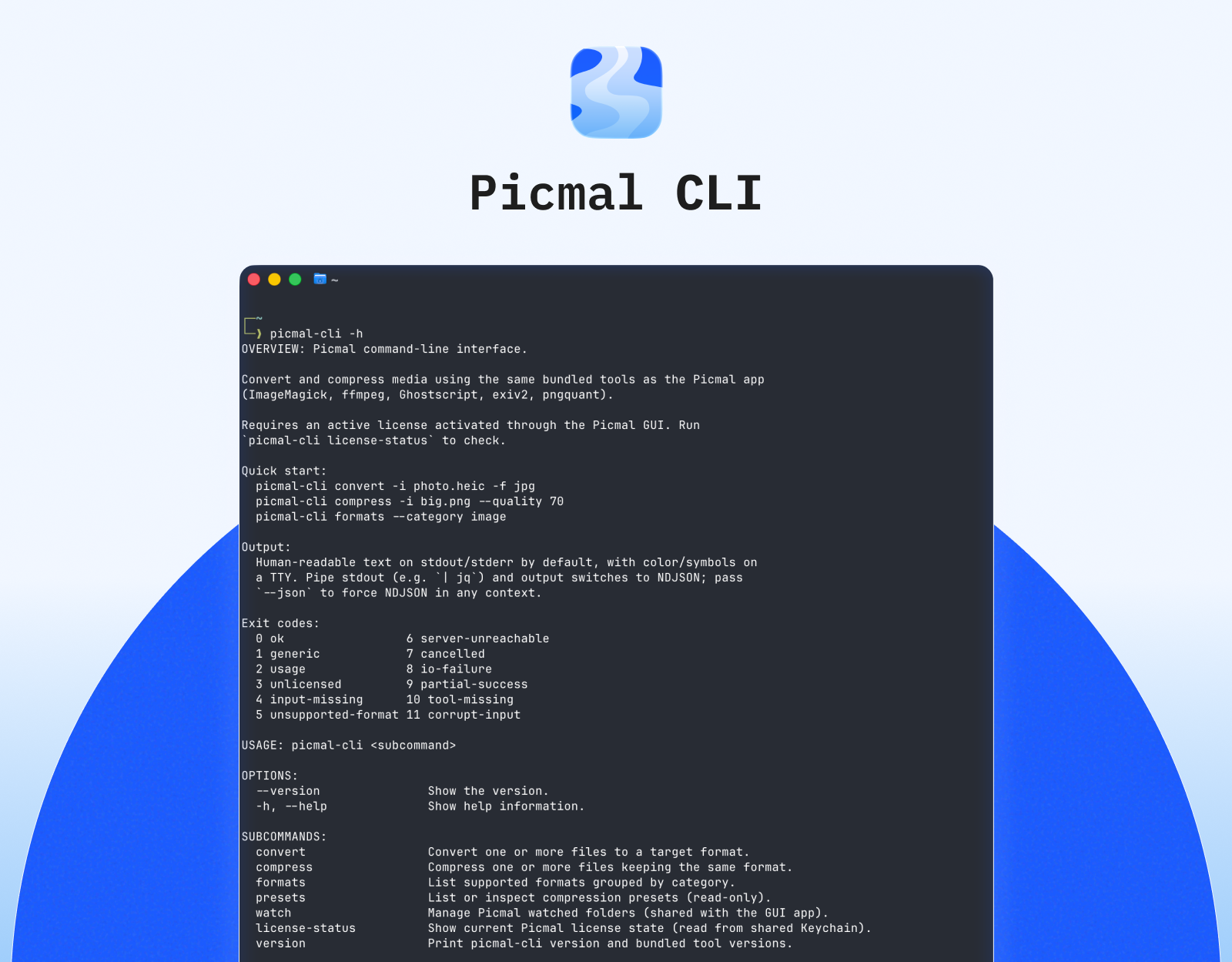
picmal-cli -h showing the Picmal command line interface help screen with subcommands, options, and exit codes

Picmal now has a command line tool. Convert and compress images, audio, and video straight from the Terminal, using the same engines as the app. Run picmal-cli convert -i photo.heic -f jpg, picmal-cli compress -i big.png --quality 70, or picmal-cli watch to monitor a folder. It supports presets, resizing, metadata stripping, color space and DPI options, and watermarks, and outputs NDJSON when you pipe it into other tools. It uses your existing Picmal license. See the CLI docs for the full reference.

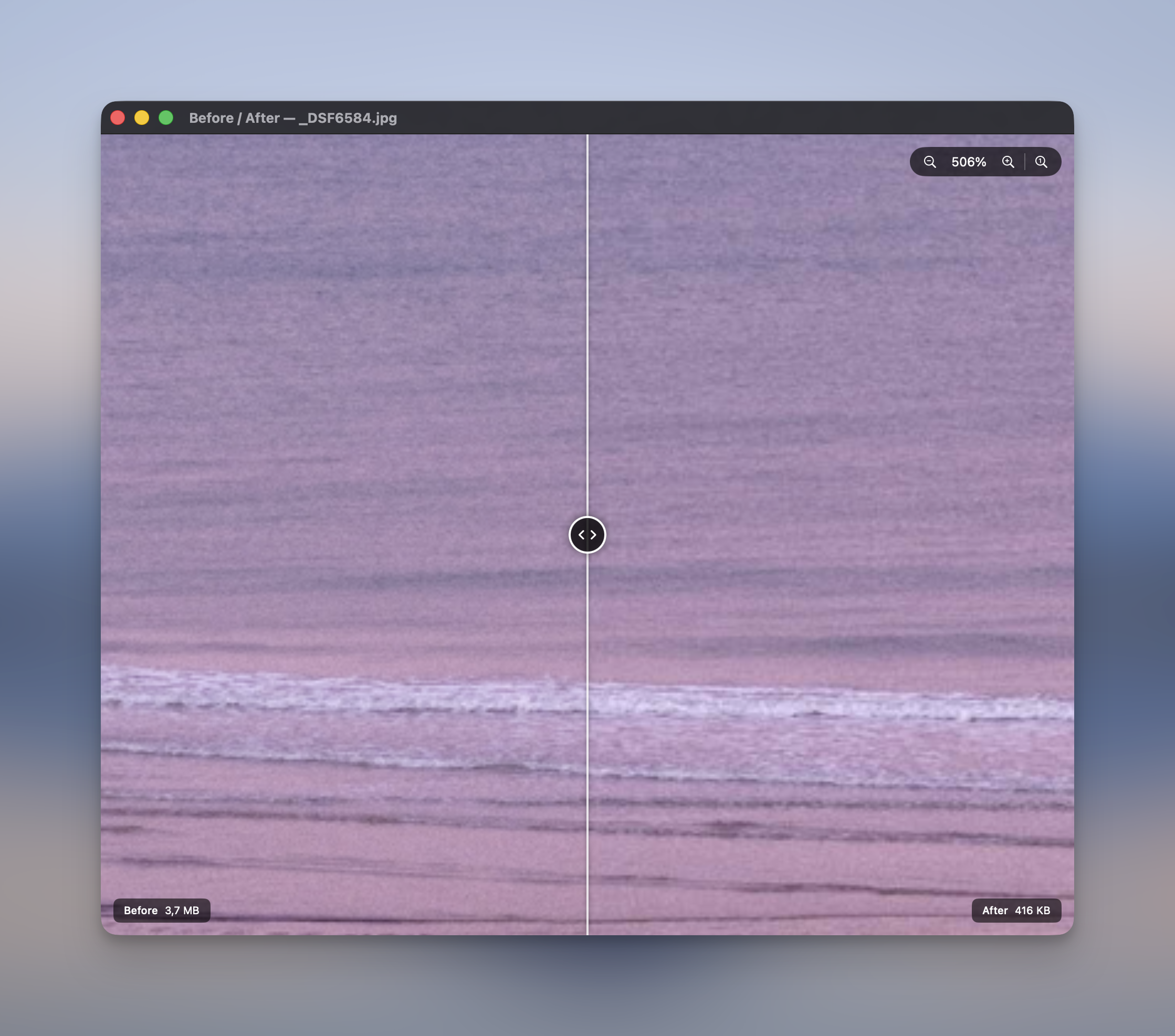
Zoom in and out in the Before/After window to inspect fine compression detail. Pinch on the trackpad, use the new +, −, and 100% controls in the corner, or press ⌘+, ⌘−, ⌘0. Drag to pan while zoomed; the slider handle still moves the divider at any zoom level. Double-click to reset.

Before/After window zoomed in to 506% on a beach photo, comparing the 3.7 MB original to the 416 KB compressed version

Fixed the Finder right-click “Convert with Picmal” and “Compress with Picmal” options doing nothing. The window now comes to the front and the files land in the list, whether Picmal was closed, already running, or hidden in the menu bar.

Fixed batch conversions failing with a temporary-file error when “Save to subfolder” was on. The output subfolder is now created up front, and if a destination really can’t be written to, only those files are marked failed instead of crashing the whole batch.

v1.6.0 Download

Embedded cover art, space saved, and scheduled batches

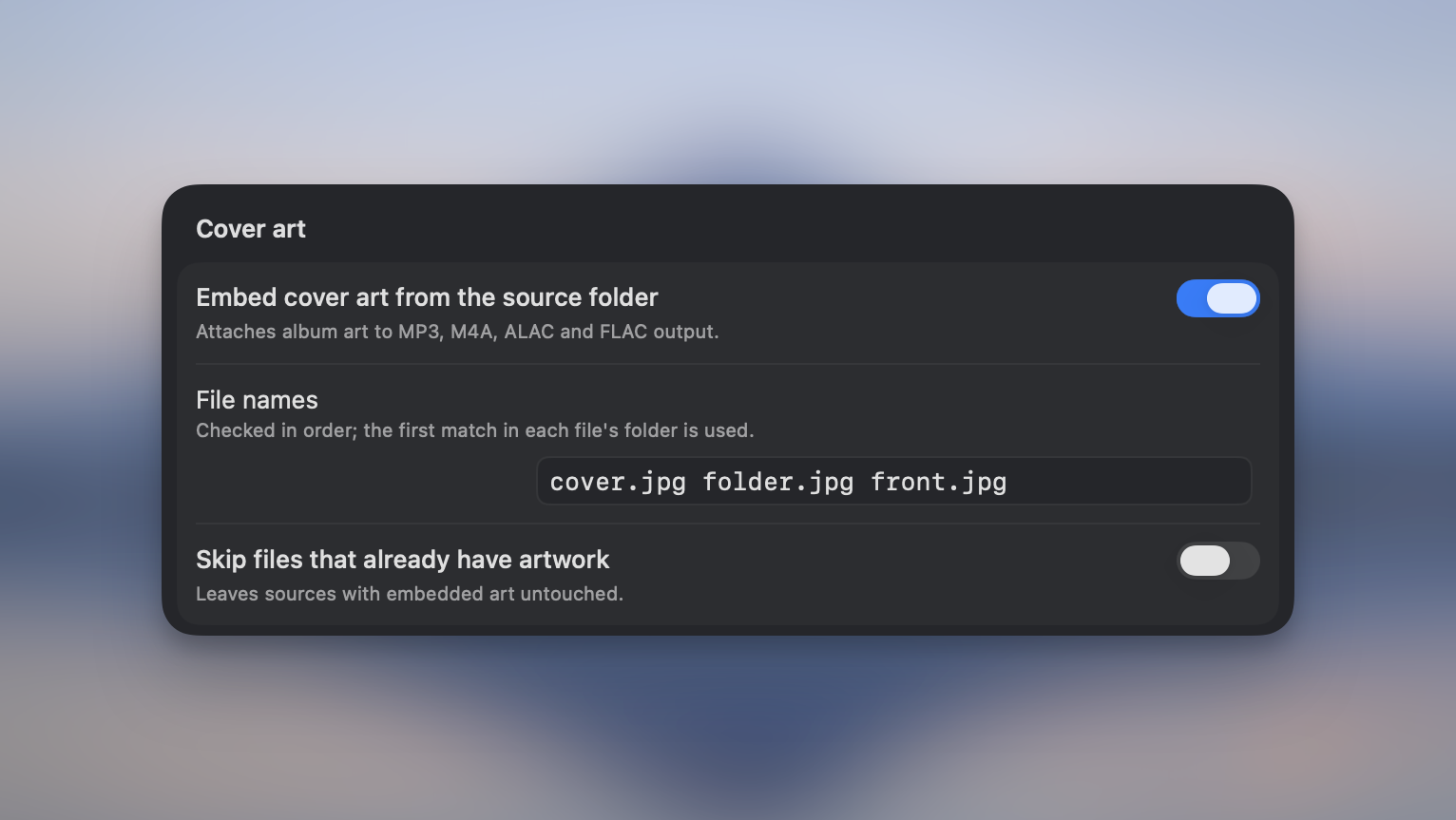
Embed album art into audio automatically. Turn on “Embed cover art from the source folder” in Settings → Audio and Picmal looks for a cover image next to each track (cover.jpg, folder.jpg, front.jpg, all editable) and adds it to MP3, M4A, ALAC and FLAC output. “Skip files that already have artwork” keeps any existing cover instead of replacing it.

Cover art settings in Picmal, with the source-folder filename list and skip-existing toggle

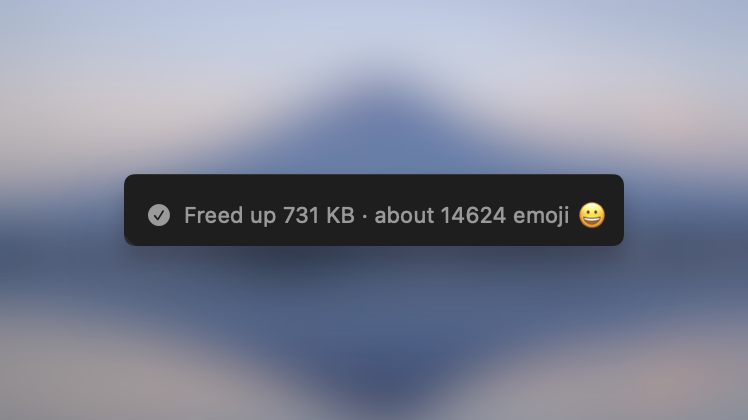
See how much space you saved after compressing. When a batch finishes, the bottom bar and the completion notification show the total freed space with a playful comparison, like “Freed up 9.66 GB · about a 4K movie 🎬”.

Picmal notification reading "Freed up 731 KB · about 14624 emoji"

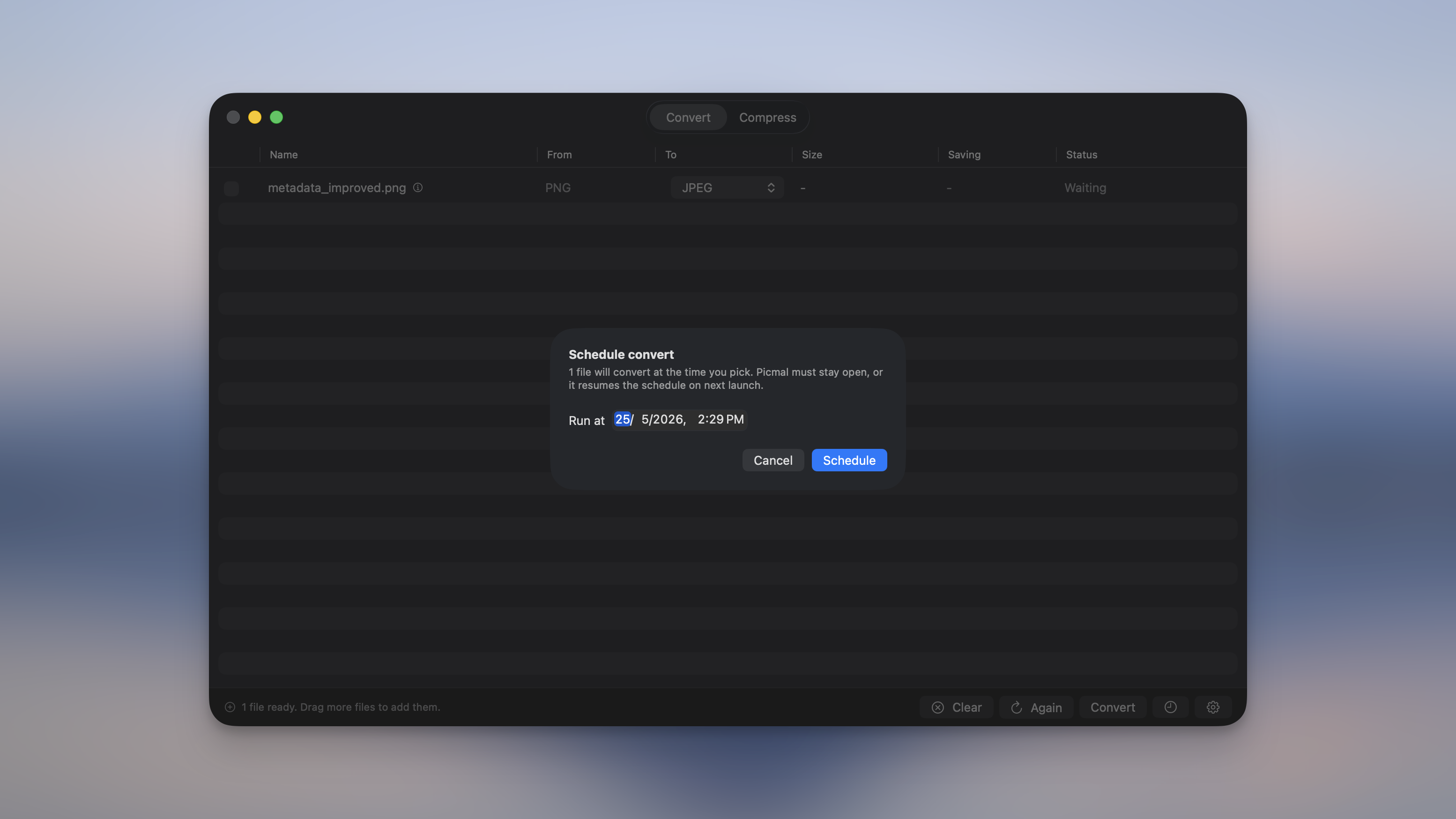
Schedule a batch for later. Tap the clock button next to Convert (or Compress) to pick a start time, handy for running big jobs overnight. The bottom bar shows what’s queued, you get a notification when it finishes, and schedules survive quitting and reopening Picmal.

Schedule convert dialog in Picmal with a date and time picker

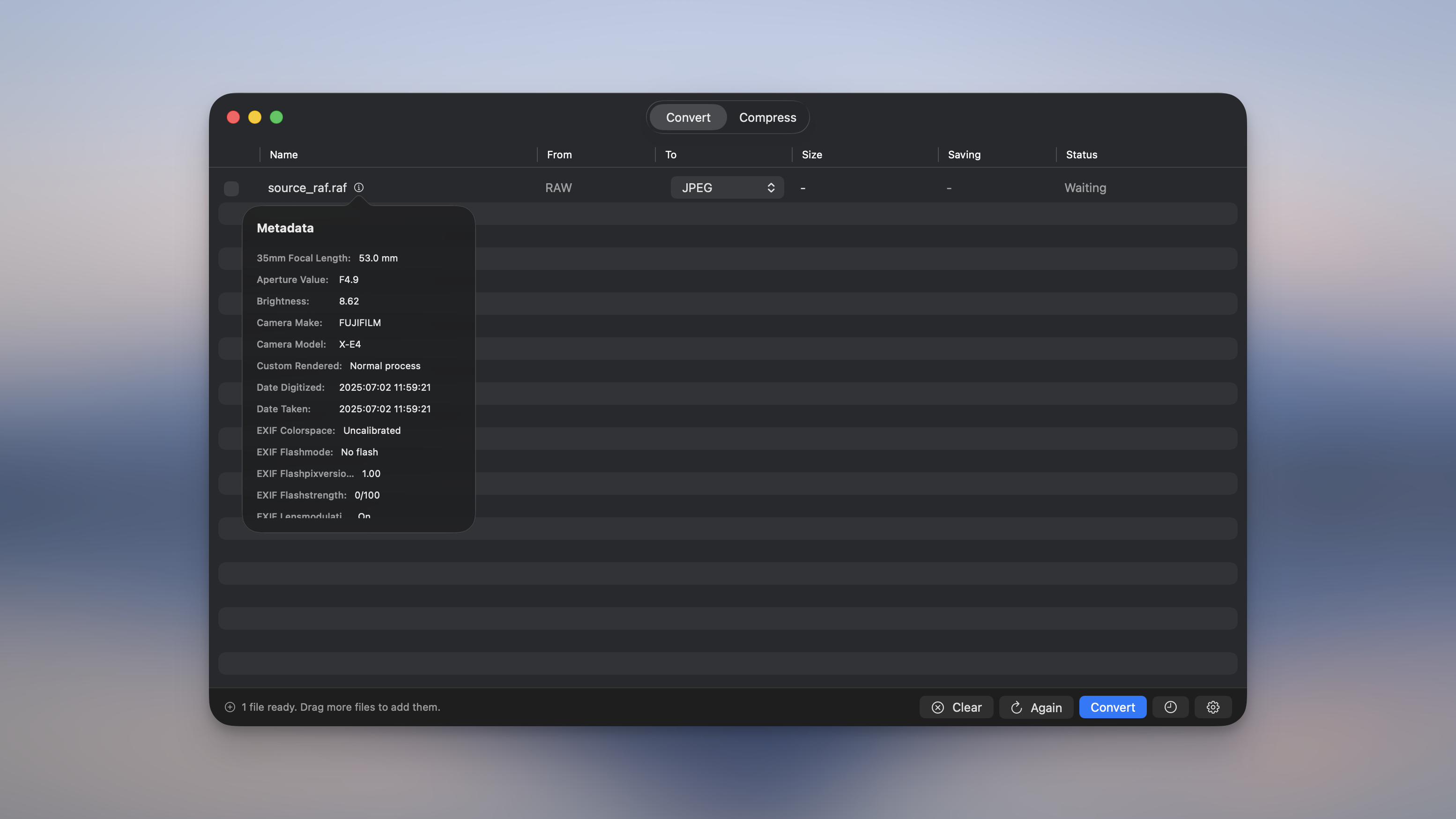
Converting RAW photos (NEF, CR2, ARW, RAF, DNG) now keeps your camera metadata. With “Keep all metadata” the output JPEG carries the make, model, lens, exposure, date and GPS. “Keep essential” keeps the basics while dropping location and serial numbers. The metadata indicator now reads RAW files too, so it no longer shows them as empty.

Metadata popover for a RAW file in Picmal showing camera make, model, aperture, and capture date

v1.5.9 Download

Video size estimates, file priority, and pause/resume

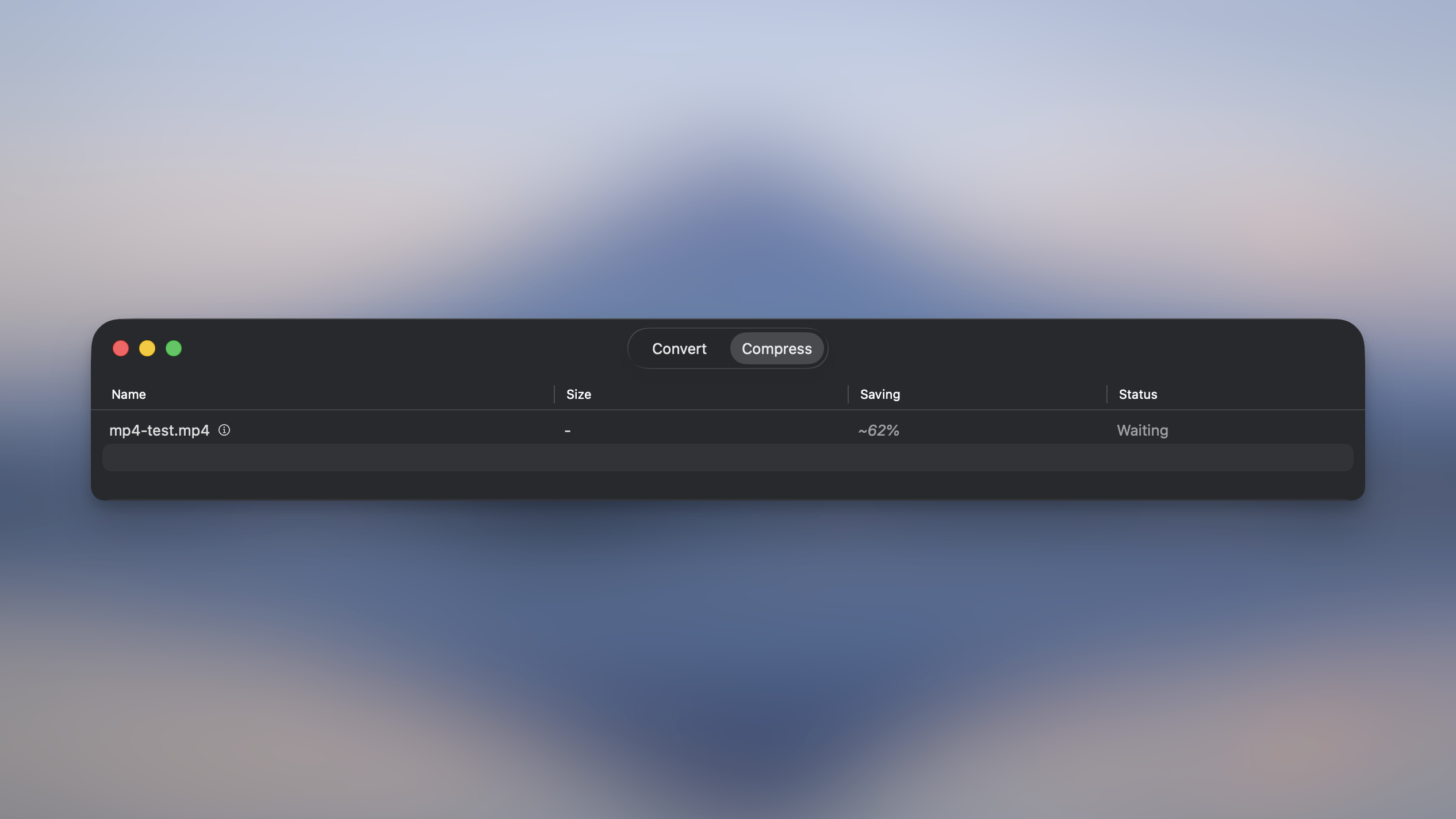
See an estimate of a video’s compressed size before you run it, so you know roughly how much space you’ll save.

Estimated saving shown before compressing a video in Picmal

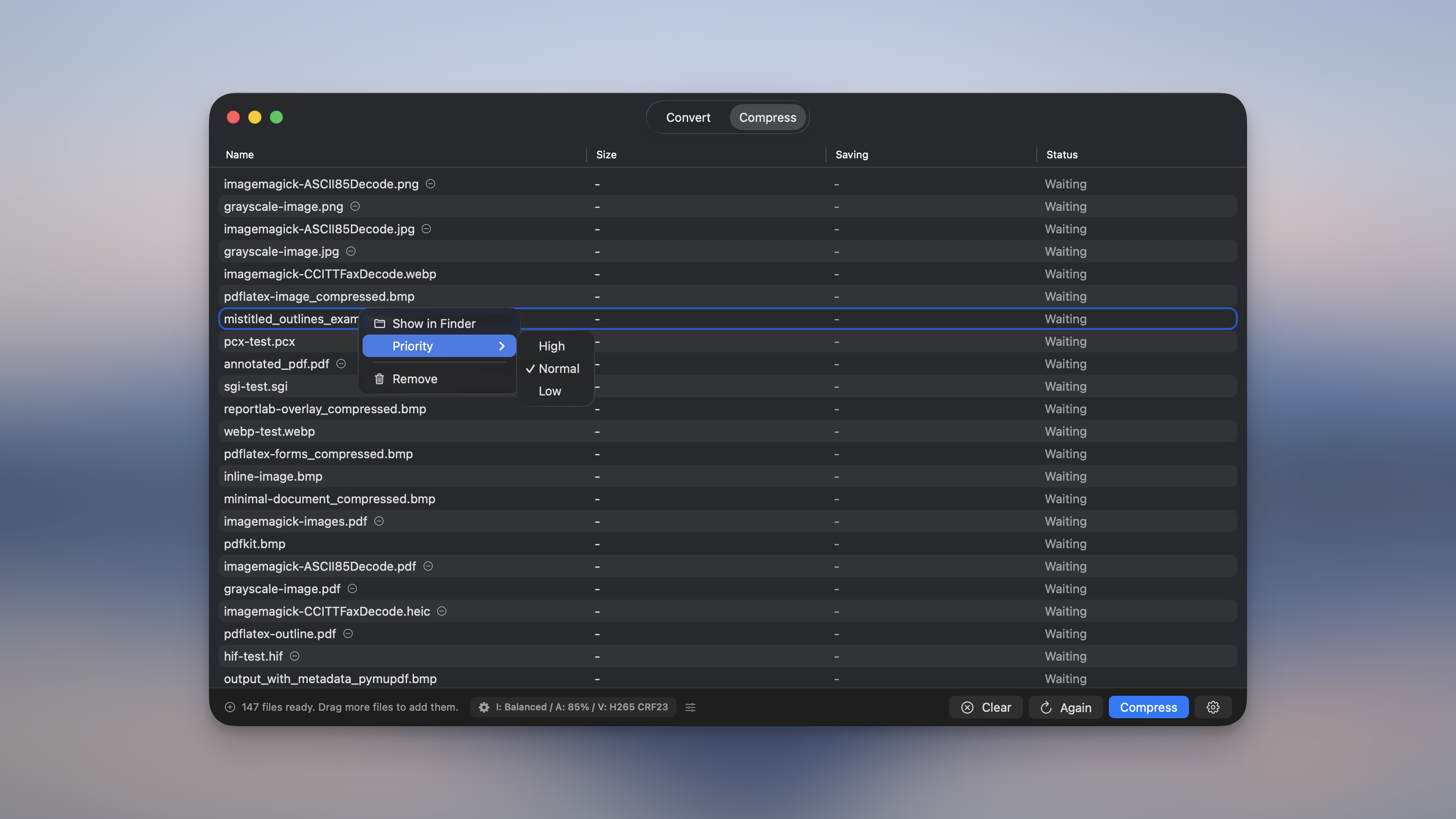
Set a priority on any file. Right-click and pick High, Normal or Low, and high-priority files get processed first, even mid-batch.

Right-click menu showing Show in Finder, Priority, and Remove options in Picmal

Pause and resume a running batch. Pause now stops files mid-conversion too, not just the ones still waiting.

Pause and Cancel controls while a batch is compressing in Picmal

Right-click any file to show it in Finder, set its priority, or remove it from the list. The old “File” column is gone, since Show in Finder now lives in the menu.

ALAC (Apple Lossless) conversions are now truly lossless. Converting FLAC to ALAC used to produce a smaller, lossy AAC file by mistake.

Fixed Adobe RGB conversions failing on macOS 26 with an “UnrecognizedColorspace” error. Picmal now resolves ICC profiles across macOS versions and skips color conversion cleanly when a profile is genuinely missing, instead of failing the whole batch.

Old FLV videos with mono Speex audio now convert instead of failing at the end with an encoder error.

Big batches no longer stall on the last file or two. If an image encoder gets stuck, Picmal kills it and retries within about 15 seconds.

The file list scrolls smoothly while processing, and the “X of Y files compressed” count no longer freezes just short of the total.

PDF compression never hands you a file bigger than the original. If it wouldn’t save space, Picmal keeps your original.

Cancelling a batch now stops quickly and tidies up, so interrupted files return to “Waiting” instead of looking stuck.

Other smaller fixes and improvements.

v1.5.8 Download

Audio bit depth, watermark scaling, and PDF rasterization DPI

Watermarks were sometimes skipped on a few files in a batch. Fixed. Every image gets the watermark now.

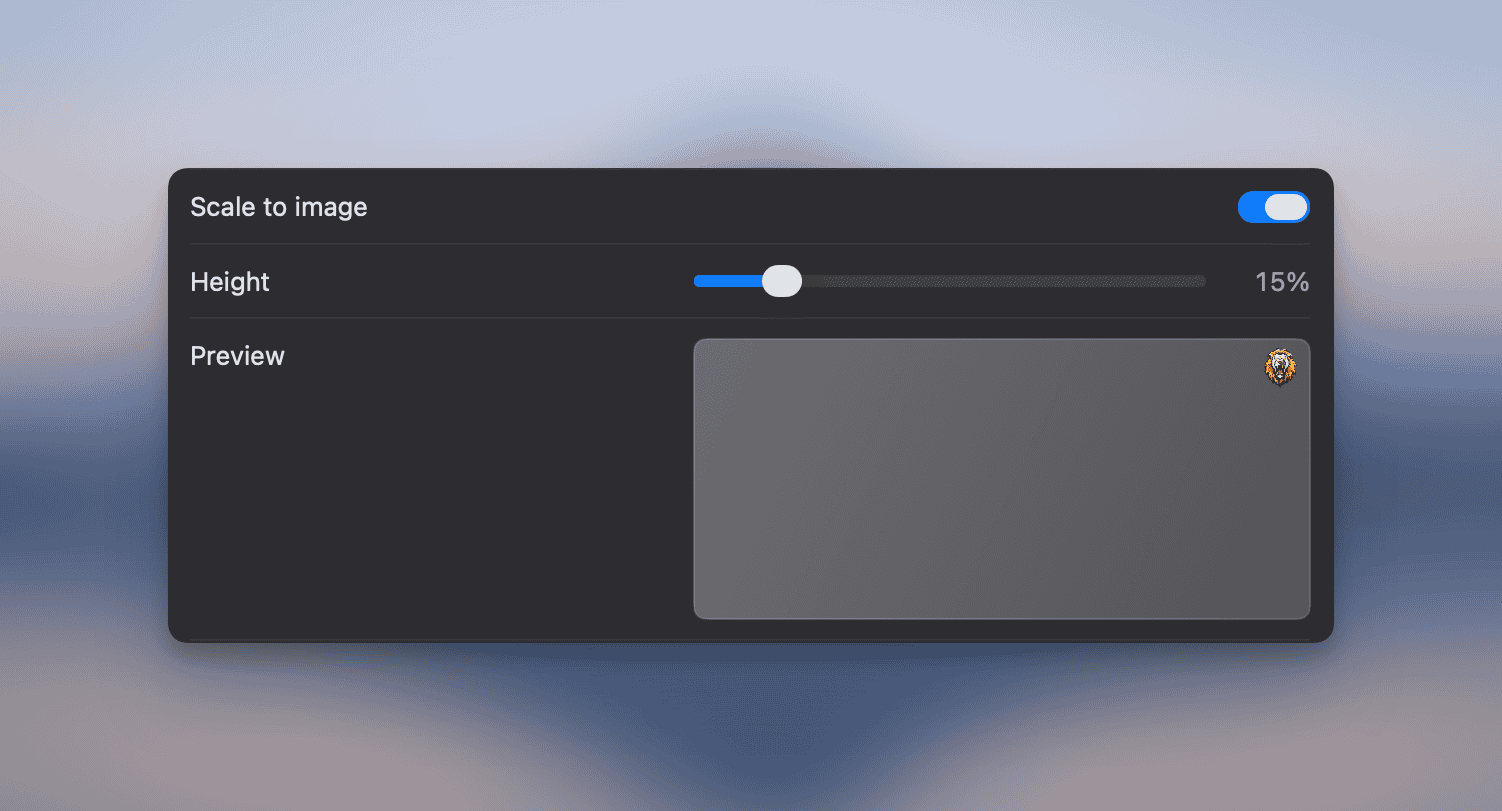
Watermarks can scale to a percentage of each image’s height, so one preset looks right across photos of any size. Turn on “Scale to image” in the watermark editor and drag the slider.

Scale to image setting in the watermark editor

“Keep all metadata” was quietly dropping some tags. It actually keeps everything now.

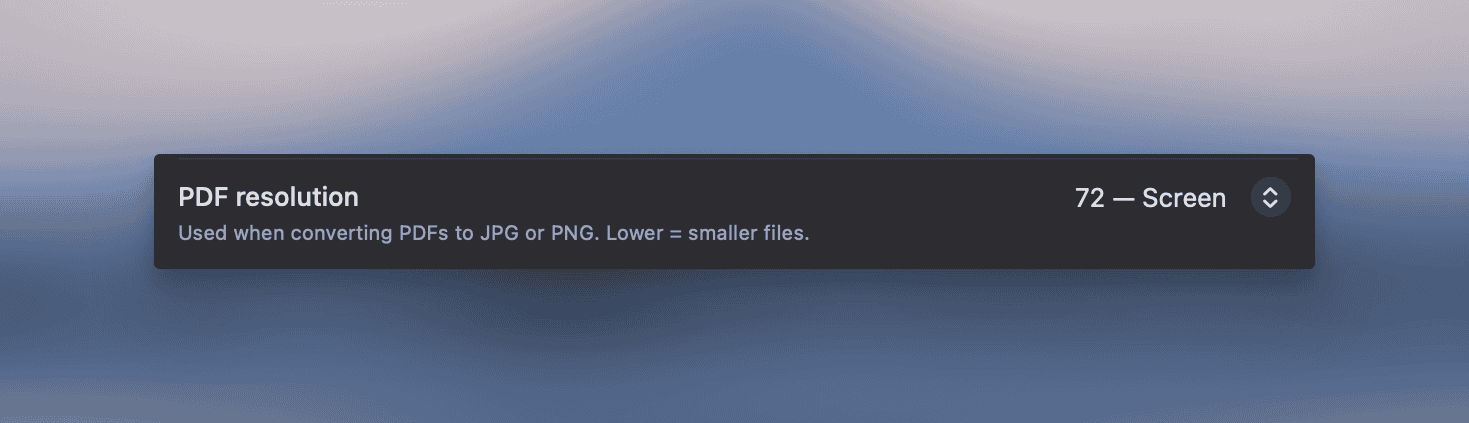
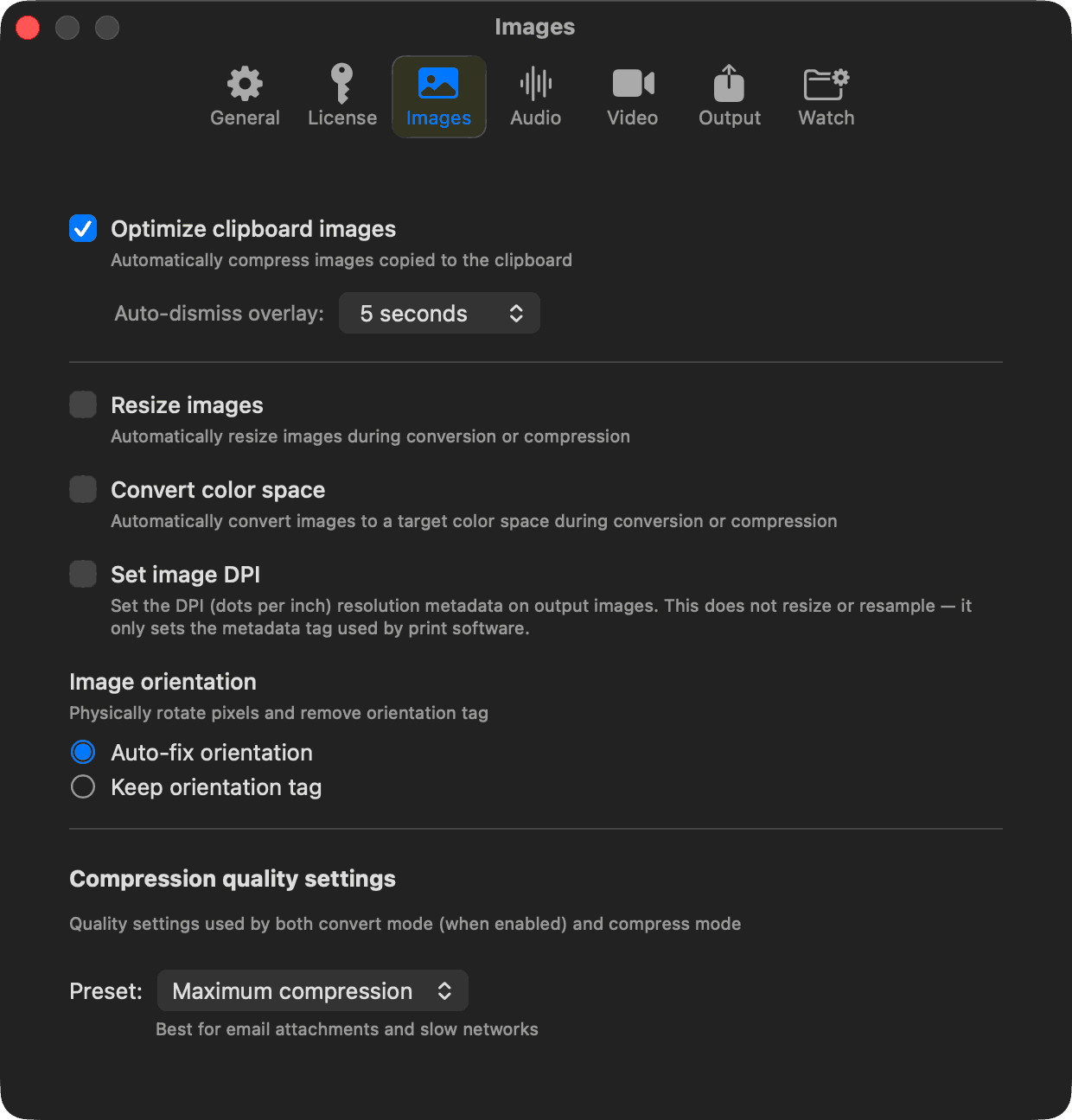
PDF to JPG/PNG no longer dumps huge files on you. Pick the rasterization DPI in Settings → Images (72, 150, 300 or 600). Default is 150.

PDF rasterization DPI setting in Picmal

Drag-and-drop used to silently cap at 100 files. You can now drop up to 10,000 in one go and they all land in the list.

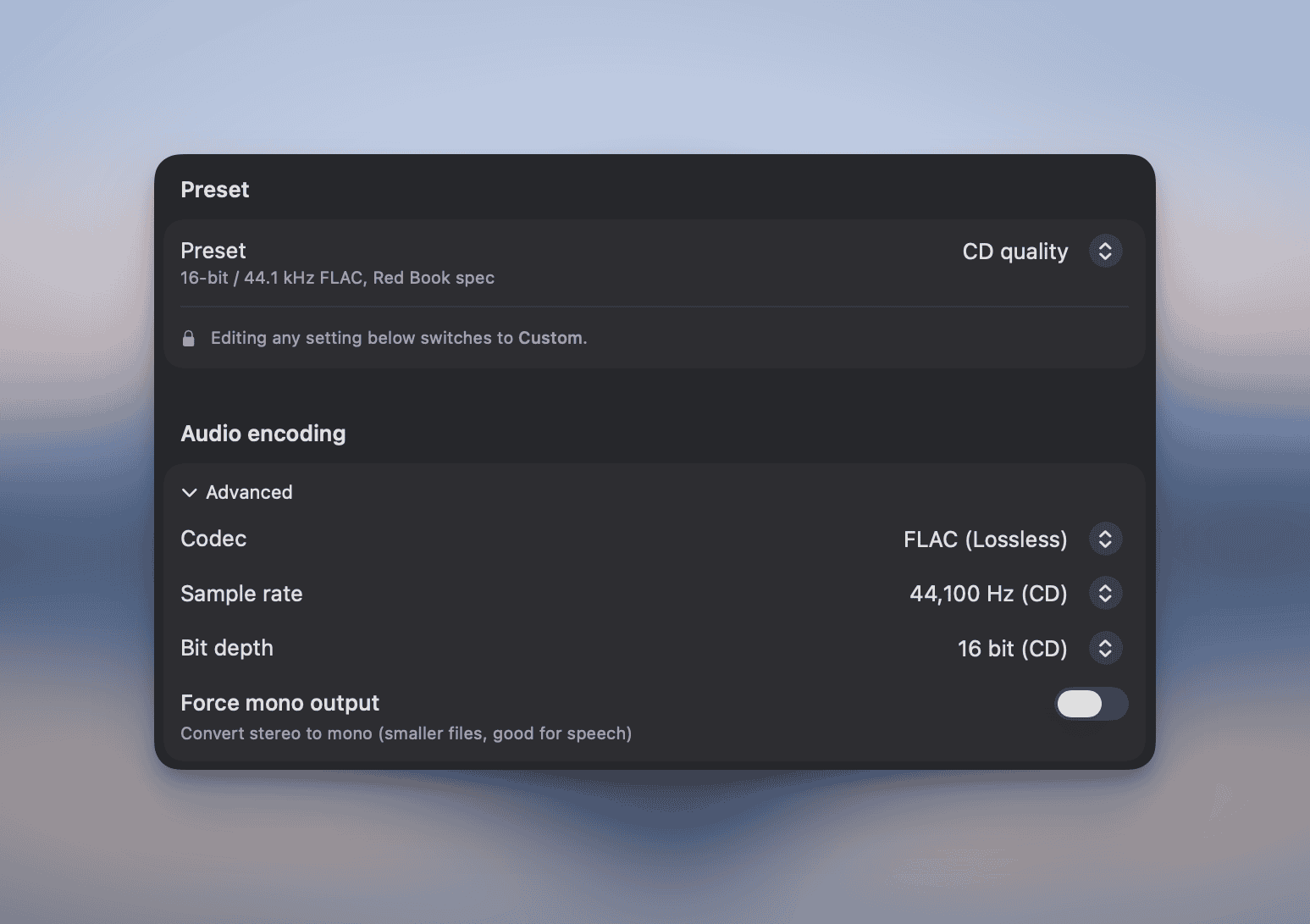
Audio conversions now let you pick a bit depth (16, 24 or 32 bit) on top of the sample rate. The new “CD quality” preset is 16 bit + 44.1 kHz FLAC.

CD quality preset and bit depth setting in Picmal

Picking Display P3, Adobe RGB, ProPhoto RGB, Rec. 709 or Rec. 2020 as the output color space used to fail outright. Only sRGB worked. Fixed.

v1.5.5 Download

Save your own compression presets, plus ALAC output

Save your own custom compression presets for images, audio, and video. Tweak the settings you like, hit “Save as preset”, give it a name, and it shows up alongside the built-in presets next time you compress.

ALAC (Apple Lossless) is now an output format. Convert FLAC, WAV, or AIFF to a lossless .m4a that imports straight into Apple Music.

Other smaller fixes and improvements.

v1.5.4 Download

Save outputs in a subfolder beside each source file

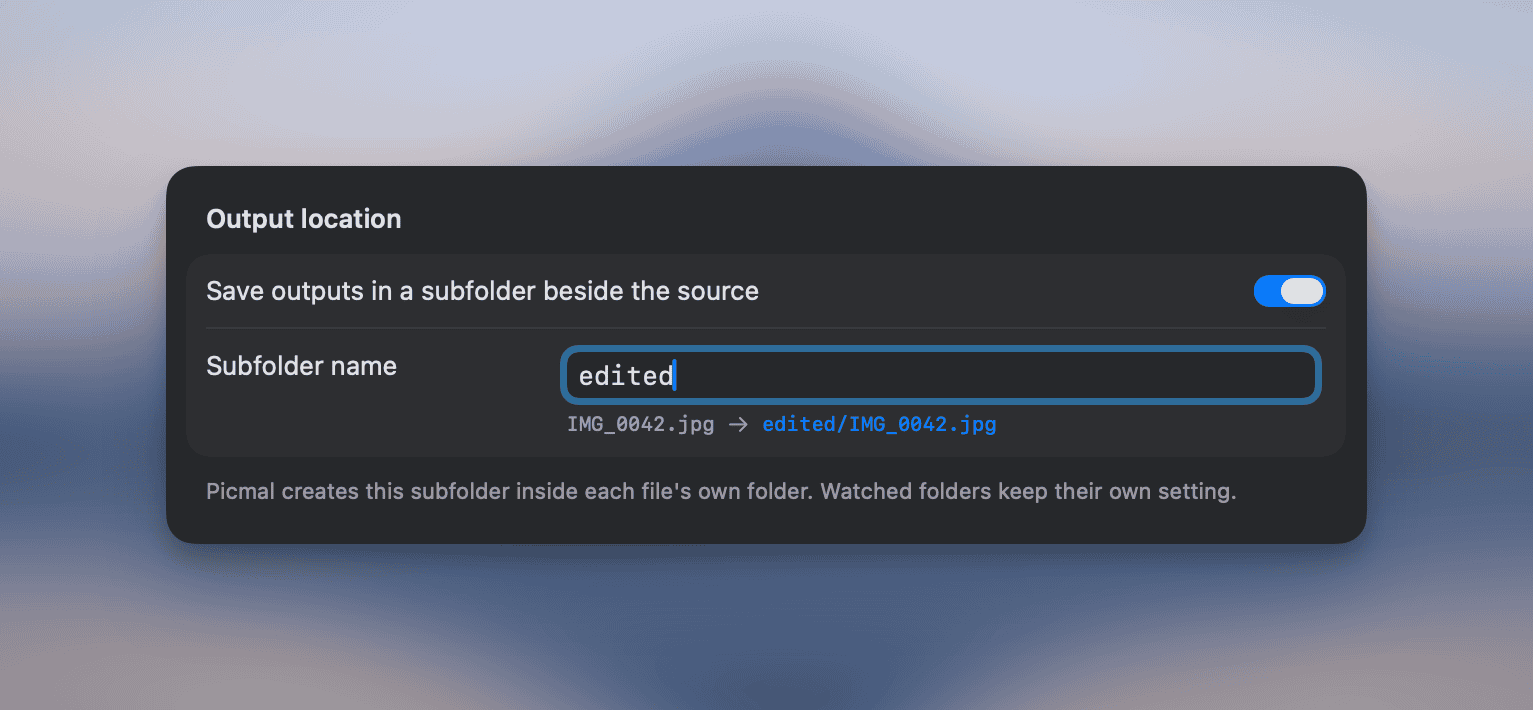
Save outputs in a subfolder beside each source file. Turn it on in Settings → Output, type a name (e.g. “compressed”), and every conversion or compression for that file is written to <sourceFolder>/<name>/. Files dropped from different folders each get their own subfolder, so originals stay untouched. Works for images, audio, and video, in both Convert and Compress.

Output location subfolder setting

Fixed AVIF compression failing silently. AVIF files now compress like any other image.

RAW photos (DNG, CR2, NEF, ARW, RAF) now show a clear message when you drop them into Compress, so you know to use Convert instead. Before, clicking Compress did nothing and there was no feedback.

Other smaller fixes and improvements.

v1.5.2 Download

Larger WebP to GIF conversions and clearer errors

Fixed larger WebP files failing to convert to GIF. Animated and high-resolution WebPs now get a 5-minute conversion ceiling instead of being killed at 2 minutes, and the error message is clearer when a source is genuinely too large or has too many frames.

Other smaller fixes and improvements.

v1.4.9 Download

EXIF-based filename patterns

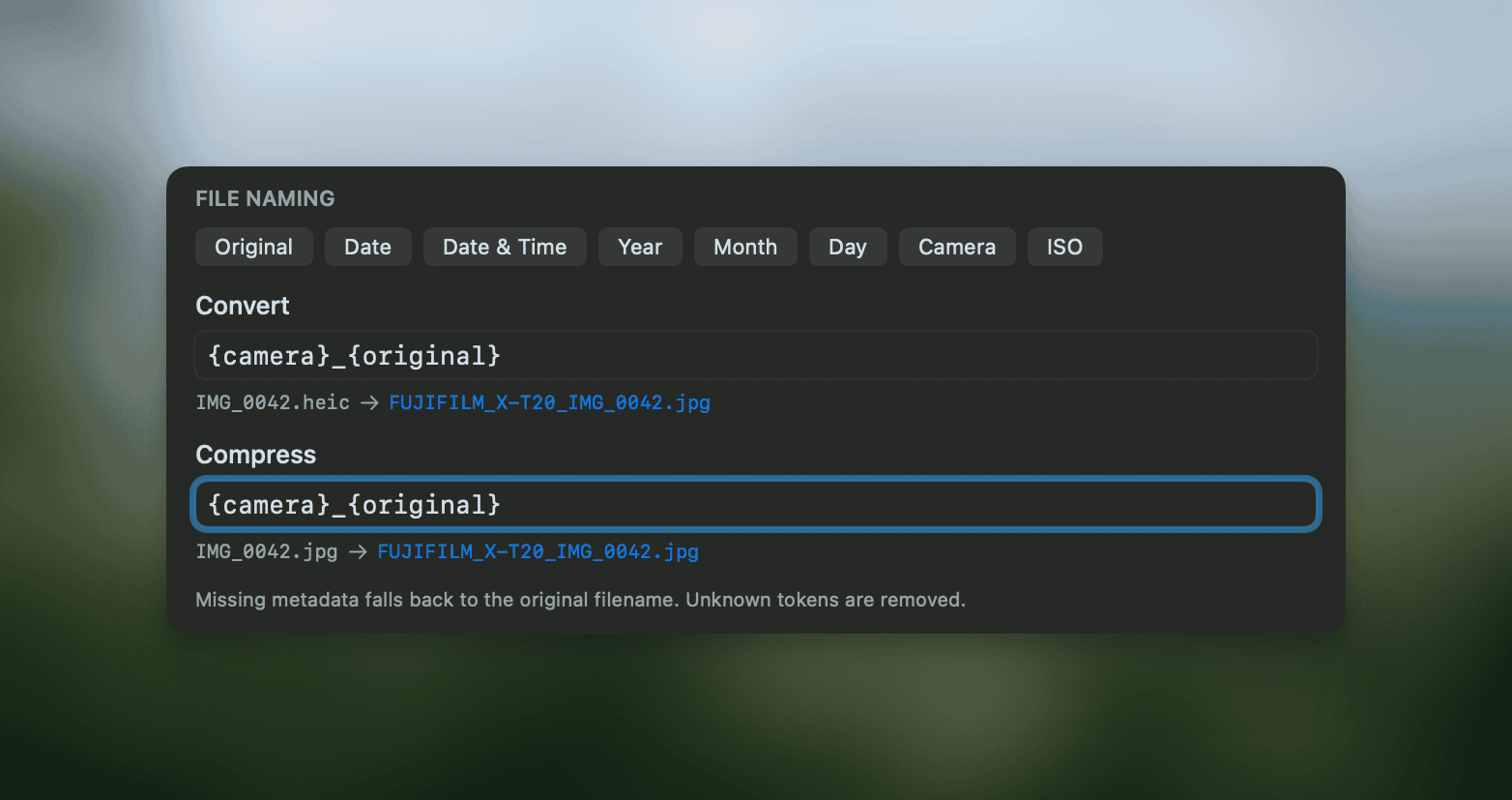
You can now rename output files using EXIF metadata. Set a pattern in Settings → Output and Picmal fills in the tokens from each file’s metadata as it processes them.

File naming settings with EXIF token pattern and live preview

Handy for sorting shots by date, grouping by camera, or just getting away from IMG_0042 as a filename.

A handful of smaller fixes and improvements round things out.

v1.4.8 Download

Watermark polish and faster image conversions

The watermark section got a proper pass. The visual glitches that snuck in with 1.4.7 are gone, alignment behaves, and the presets UI no longer fights you when you’re trying to pick a position or tweak opacity.

Image conversions are also noticeably quicker. Same output, less waiting, especially on larger batches.

A handful of smaller fixes and improvements round things out.

v1.4.7 Download

Burn-in subtitles, playback speed and watermarks

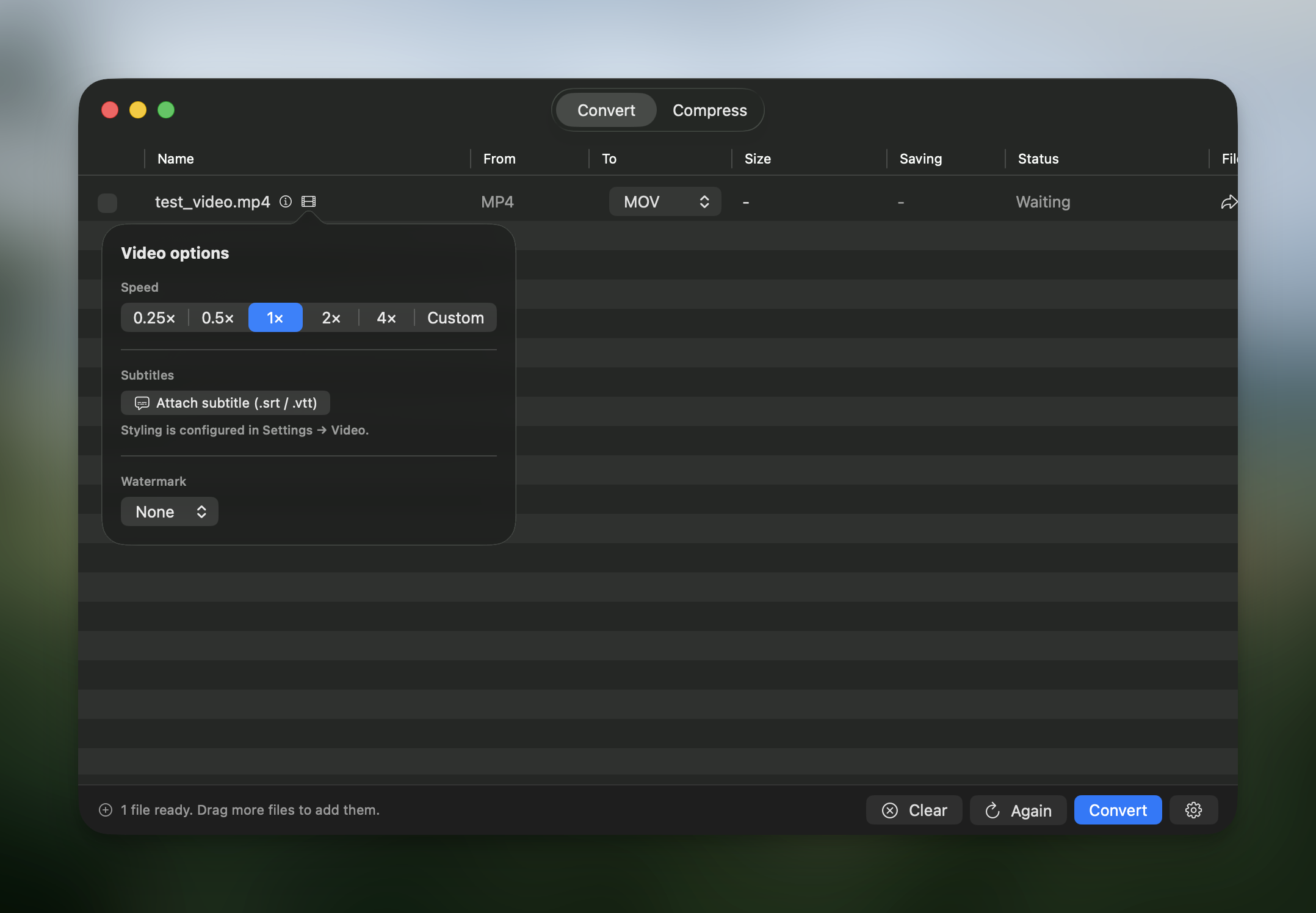
There’s a new film icon next to every video. Click it, drop in an SRT or VTT, and the subtitles get baked right into the output. No sidecar file, no player roulette where half your viewers see nothing. Style them in Settings → Video: size, color, and whether they sit at the top, middle or bottom.

Same icon, second trick: playback speed per video. Pick 0.25×, 0.5×, 2×, 4×, or type in any custom percentage between 10% and 800%. Pitch stays put, so 2× won’t chipmunk your narrator. Doing the same speed across a whole batch? Hit “Apply speed to all videos” and be done.

Video options panel with speed presets and subtitle attachment

Watermarks finally landed for videos. Drop in a logo or a PNG, save as many presets as you want, and pick position (9 anchors), margins and opacity from Settings → Watermark.

And a fix that should have shipped ages ago: resize settings were quietly ignored during Compress. Max Dimensions, Max Width/Height and friends now behave the same in Compress as they do in Convert.

v1.4.6 Download

Redesigned Settings and smarter clipboard optimization

Settings got a redesign. Things are where you’d expect now, and a few toggles nobody was using quietly left the building.

If your license is already active on another device, the activation error finally says so, with a link to the deactivation docs. No more staring at a red box wondering what you did wrong.

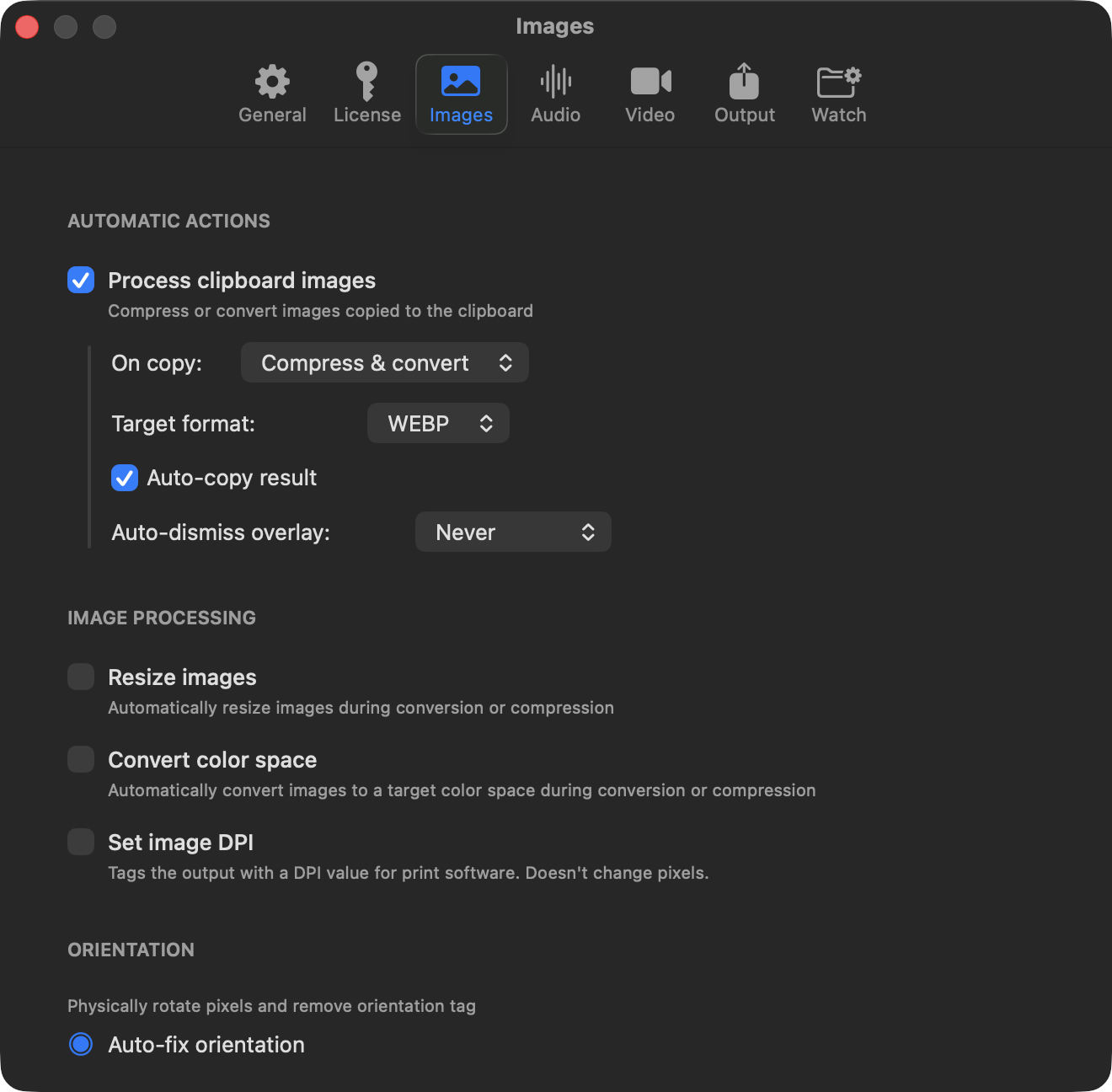
Clipboard optimization picked up a few tricks. Copy an image and you can have Picmal compress it, convert it to JPEG, PNG, WebP, HEIC, AVIF, TIFF or GIF, or both at once.

Clipboard optimization settings in the redesigned Settings window
v1.4.5 Download

Batch conversion fixes and overwrite warnings

Batch conversions could hang forever, stuck at 99% or 0%, if you threw enough files at them. Fixed. Your fans should also stop spinning after conversions finish now.

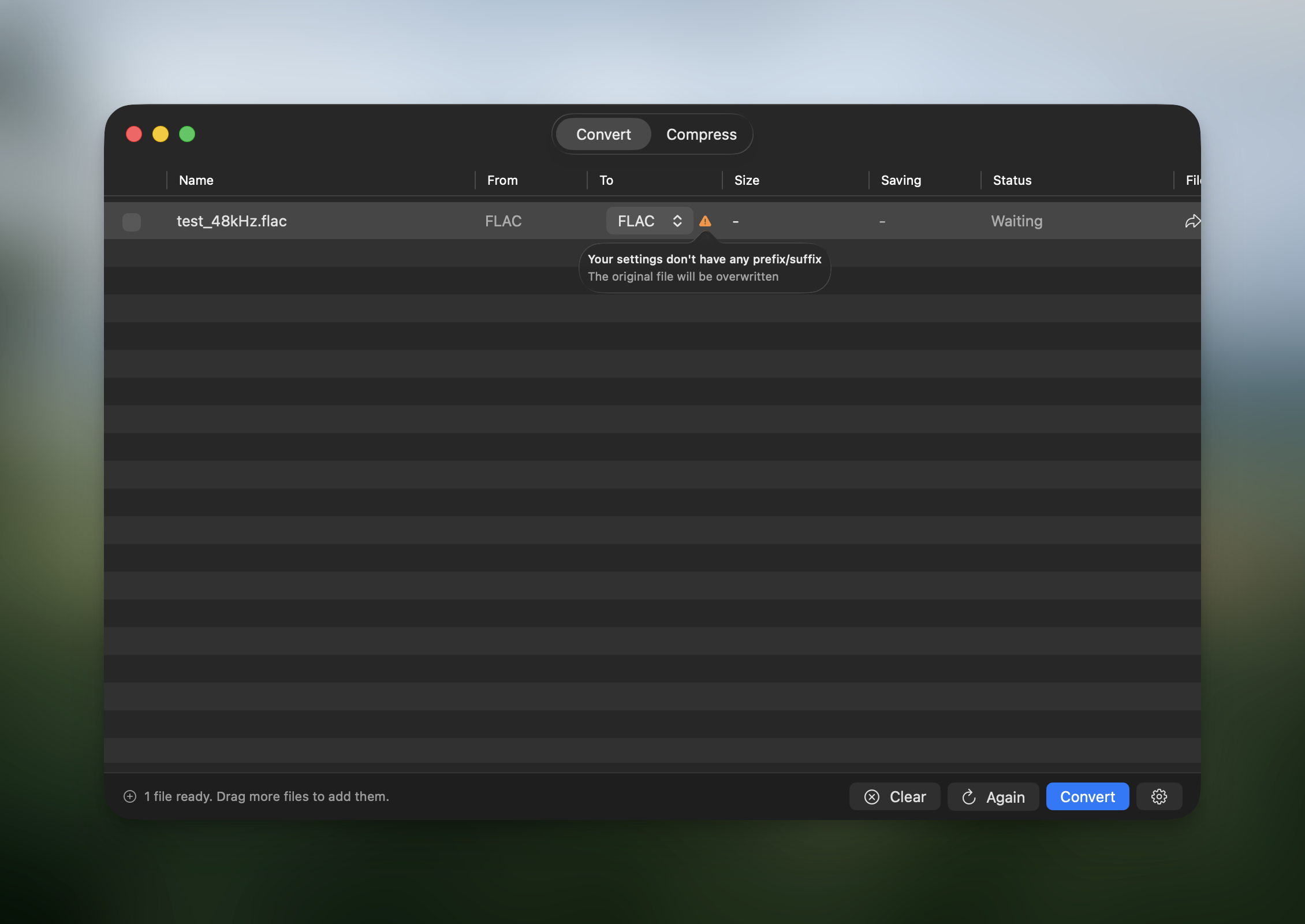
You’ll see a warning icon in the convert table when a same-format conversion would overwrite the original file. Same goes for the compress bottom bar when prefix/suffix are empty. The Output settings page flags these per section too, so you’ll catch it before anything gets clobbered.

The automatic “_converted” suffix for same-format conversions is gone. Use prefix/suffix settings instead.

JPEG compression failures now capture error output, so when something breaks you actually get to see why.

Overwrite warning in the convert table
v1.4.4 Download

Audio resampling and same-format conversions

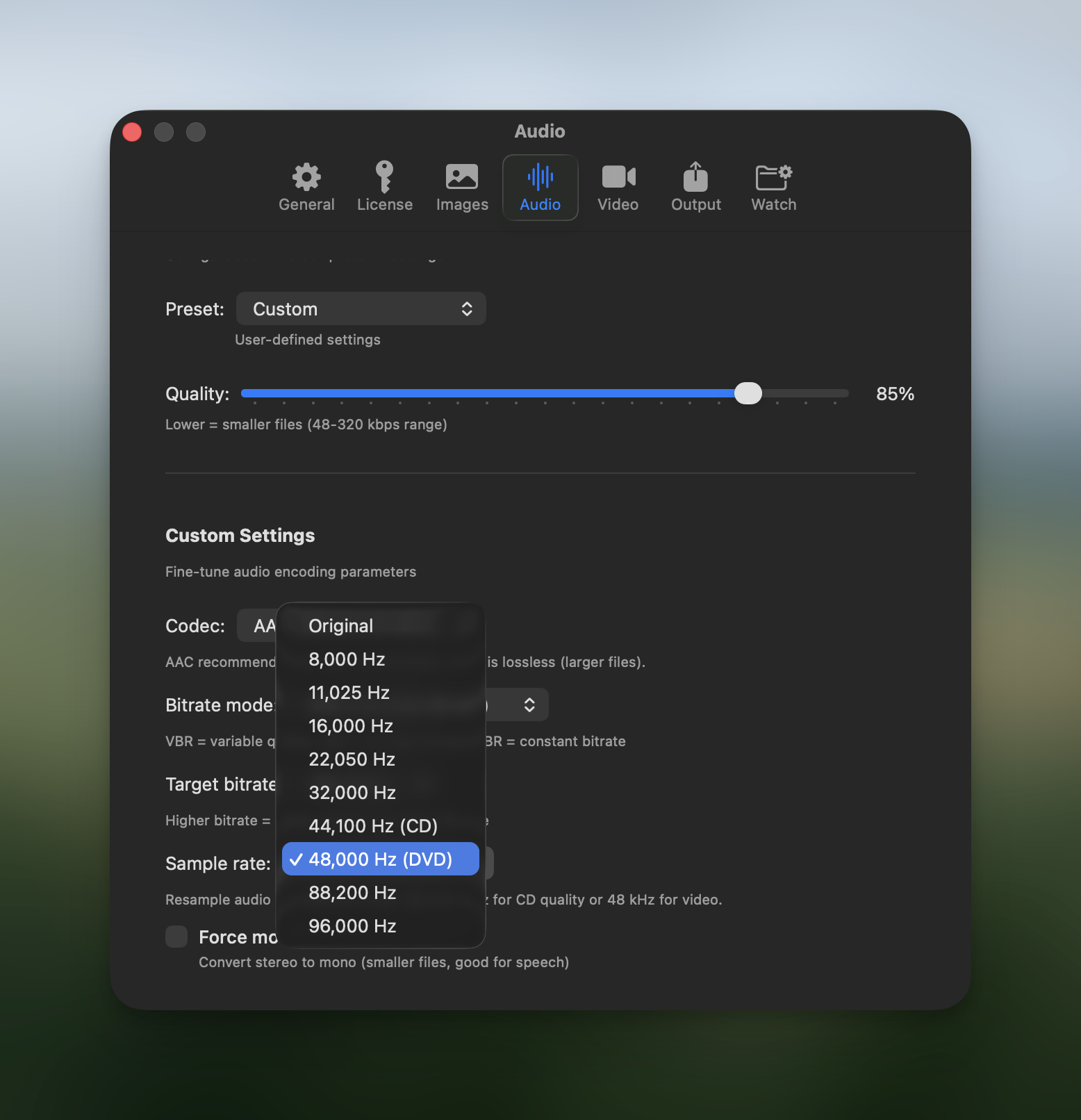
You can now convert audio files to the same format they’re already in. Sounds pointless, but it’s how you resample: FLAC to FLAC at a different sample rate, without touching the codec. The new sample rate picker in Audio > Custom preset offers 8 kHz through 96 kHz, including the usual suspects (44.1 kHz for CD, 48 kHz for DVD).

Same-format conversions add a “_converted” suffix automatically, so your original stays untouched.

Plus a handful of smaller fixes.

Sample rate setting in Audio Custom preset
v1.4.2 Download

Corrupted video detection, notch progress overlay, and faster launch

Corrupted video files (missing moov atom, truncated streams) now get a clear error message instead of silently failing. The error UI has been cleaned up too.

Launch is faster. The app no longer waits on non-essential setup before showing the window.

System notifications are gone. Instead, a progress overlay animates down from the MacBook notch (or slides in on other displays). The menu bar icon shows live progress percentages, so you can track conversions without switching back.

Cancelling a conversion no longer causes a brief UI freeze. Fixed several concurrency bugs in ServiceHandler, SharedTempFileManager, and FFmpegConverter.

Plus smaller fixes.

v1.4.1 Download

Bug fixes, per-folder resize, and video format conversion

JPEG compression was silently producing truncated output. Fixed. Also killed the high idle CPU usage, which turned out to be a pile-up of aggressive clipboard polling, always-on cache timers, broad UserDefaults observation, and unbatched FSEvents.

Watched folders now have per-folder resize settings and a “compress after convert” toggle, so each folder can behave differently without touching global preferences.

Clipboard optimization gets an auto-copy mode: compressed images go straight back to the clipboard without the extra “Copy” click. Off by default.

Video compression lets you swap the output container (MOV to MP4, MKV, WebM, AVI) with automatic codec compatibility.

v1.4.0 Download

Before/after preview and advanced video compression

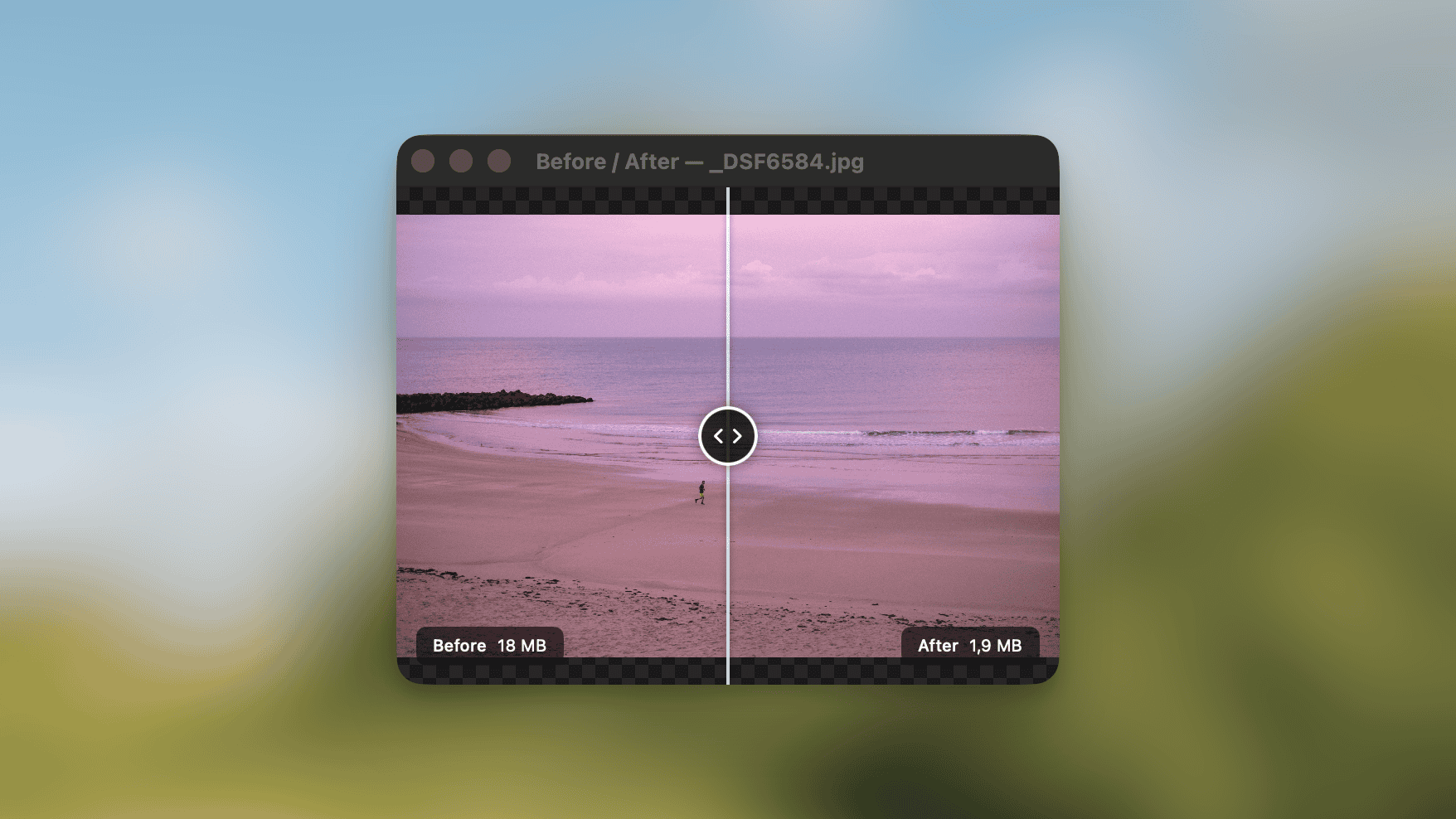
Click the screen icon on any processed file to open a before/after slider. Useful for checking whether your quality settings are too aggressive or too conservative.

Video compression now goes from CRF 0 to 51 for finer quality control, and a new frame rate setting lets you drop fps (60 to 30, say) for smaller files.

Before and after preview with interactive slider in Picmal

v1.3.9 Download

Smart format memory and improved clipboard overlay

Picmal now remembers your last output format per input type. If you always go HEIC to JPG, it stops asking.

The clipboard overlay auto-dismisses after a configurable timeout (5 seconds by default) and no longer shows up in macOS screenshots.

Auto-dismiss overlay setting in Picmal preferences

v1.3.8 Download

Clipboard optimization, improved WebP to GIF, and DPI controls

WebP to GIF now preserves every frame in animated files, and static WebP conversions no longer fail randomly.

Clipboard optimization: copy an image and Picmal compresses it instantly. A small overlay appears with the lighter version ready to paste. No extra steps.

You can now set DPI metadata on output images: 72, 96, 144, 150, 300, 600, or a custom value. This tags the resolution info for print workflows without changing actual pixel dimensions.

v1.3.6 Download

Metadata controls, iCloud Drive support and HEVC video fixes

Three metadata modes: strip everything, keep essentials (orientation, colour profile, copyright), or preserve all. Handy when you want privacy without losing colour accuracy.

Conversion now works on iCloud Drive, network shares, and read-only locations. No more “permission denied” when your files aren’t on the local disk.

HEVC videos with unusual frame rates convert correctly to MOV and play in QuickTime. Other minor fixes.

v1.3.5 Download

Drop files into the menu bar

Drop files and folders straight into the menu bar icon to convert without opening the main window. Fastest way to handle a few files.

Also fixed dock icon drag-and-drop failing on some setups, plus a few smaller fixes.

v1.3.4 Download

Stability fix for corrupted files

Picmal could freeze on corrupted or unusually complex files. It now skips them and moves on to the next file in the queue.

Better Sentry reporting with more context around failures, so we can diagnose issues faster. Other minor stability fixes.

v1.3.3 Download

Crash detection with Sentry

Sentry is now integrated for automatic crash and error detection. When something breaks, we know about it immediately.

No personal data is collected. Only error stack traces and basic device context.

v1.3.1 Download

Better compression, clearer errors and background launch fix

Better compression across all formats. Smaller files, same visual quality.

Error messages when switching between Compress and Convert modes are actually useful now instead of generic. Video compression was broken in earlier versions (files weren’t always getting smaller), and encoding is noticeably faster.

“Keep in Menu Bar” no longer flashes the main window at login before hiding.

v1.3.0 Download

Watched folders, Shortcuts integration and background mode

Watched folders: pick a folder, set your rules, and anything you drop in gets converted or compressed automatically. Set it and forget it.

Picmal now works with macOS Shortcuts, so you can trigger conversions from any automation. Background mode keeps the app running quietly in the menu bar after login.

Compression output now covers images, audio, and video.

v1.2.9 Download

Dock icon drop, Canon HIF support and SVG fixes

Drag files onto the dock icon to start converting without opening the window. Files now persist when you switch between Convert and Compress tabs.

Added HIF format support for Canon cameras that shoot HEIF. Fixed DNG/RAW rotation, which was flipping some photos sideways after conversion.

SVG compression no longer chokes on files with certain CSS class names.

v1.2.8 Download

Conversion presets, metadata stripping and HEIC to WebP

Audio and video conversion presets: save your settings, reuse them with one click. HEIC to WebP is now supported, and metadata stripping works across images, audio, and video.

The output panel shows which settings produced each file. Preferences has been reorganised. Large parts of the conversion pipeline have been rewritten for stability.

Fixed MKV to MP4 conversions producing unusable files with certain codecs.

v1.2.7 Download

Folder support, Finder context menu and sharper PDFs

Sharper PDF output. You can now open files via File > Open or Command+O.

Drop a folder and Picmal gathers everything inside, subfolders included. Right-click any file in Finder and you’ll see new options to convert or compress with Picmal.

v1.2.6

Colour space conversion and FLAC to AAC fix

Colour space conversion: sRGB, Display P3, Adobe RGB, ProPhoto RGB, Rec. 709, or Rec. 2020, with proper ICC profile embedding. Click the icon in the Size column to inspect colour space info.

Fixed FLAC to AAC conversion in optimised advanced mode.

Color space info

Convert color space

v1.2.4

Video progress, hardware encoding and faster PDF compression

Video and audio files now show conversion speed and estimated time remaining. Video conversions are faster and lighter on memory, especially for long files.

Instant conversion (no re-encoding) works for 50+ format combinations: WebM, MKV, MP4, FLV, 3GP, and more. VideoToolbox H.264 hardware encoding on Apple Silicon covers 12+ video formats, with 10-50x speed gains for FLV, WMV, MPEG, 3GP, and others.

Fixed WebM codec compatibility in Advanced mode. Buttons are clickable during conversion again. Faster, more accurate PDF compression.

Video progress

v1.2.3

Multi-select fix and compression savings accuracy

Fixed a bug where multi-select was broken for audio and video files — the format dropdown now populates correctly when selecting media files via checkbox. Compression savings percentages are now accurate when converting between formats.

v1.2.2

Advanced mode fixes, cancel button and progress indicator

Advanced mode checkbox works again, and Advanced mode is now available in both Conversion and Compression. Tab bar text truncates properly.

Progress indicators for compression and conversion, which matter when a file takes several minutes. Cancel button to stop mid-process. Fixed some PDF compression errors.

v1.2.1

Batch image resize, media metadata and advanced mode

Batch image resize with five modes: percentage, fixed dimensions, max dimensions, width-only, or height-only.

Audio and video files show metadata (duration, bitrate, codec, sample rate) and get advanced mode with FFmpeg controls. PDF compression colours fixed for Keynote and PowerPoint exports. Compressed files now get a “_compressed” suffix automatically.

31 audio and 25 video formats supported.

v1.2.0

Audio and video support

Audio and video support. 50+ audio formats (MP3, WAV, AAC, FLAC, OGG, OPUS, and the rest) and 24 video formats (MP4, MOV, AVI, MKV, WebM, FLV, WMV).

Same workflow as images: drop, pick a format, convert.

v1.1.9

18 new conversion formats and 10 new compression formats

A big format expansion. 18 new formats now support conversion: JP2, PICT, QTIF, SGI, TGA, JXL, DDS, EXR, PBM, PGM, PPM, PNM, PCX, XBM, XPM, QOI and PSD.

10 new formats also support compression: BMP, JP2, TGA, JXL, DDS, EXR, PCX, SGI and QOI.

v1.1.8

Small fixes

A quick patch with small bug fixes.

v1.1.7

Small fixes

A quick patch with small bug fixes.

v1.1.5

SVG compression, full PDF pages and compression presets

SVG compression is here, and PDFs now convert every page instead of just the first. Drag-and-drop crash fixed. General performance improvements.

Six compression presets: maximum quality, high quality, balanced, web optimised, social media, or maximum compression. Or make your own.

v1.1.1

Auto compress mode and custom naming for compressed files

Auto compress mode (Preferences > Files): drop files and they start compressing immediately. No buttons.

Custom prefixes and suffixes for compressed output files (Preferences > Output). Leave them blank to overwrite originals. New “Clear settings” button to reset compression quality to defaults.

Fixed files not compressing correctly on output.

Auto mode enabled

v1.1.0

Compress mode

Dedicated compress mode. Shrink JPG, WebP, PNG, GIF, TIFF, AVIF, and PDF files without converting them to anything else.

Compression also works as a post-conversion step: convert first, then automatically optimise. Other minor fixes.

Compress mode available

v1.0.8

Batch format selection and conversion notifications

Select multiple files and apply one output format to all of them at once. No more setting each file individually.

Batch output format selection feature

Notifications when your files finish converting, so you can do something else in the meantime.

Notifications active

Conversion complete notification

v1.0.7

Default output formats and dark mode

Set your preferred output formats once in settings and Picmal applies them automatically on every drop.

Default format conversion settings

Dark mode. Settings > General. The settings menu has been redesigned too.

Dark mode interface

Dark mode setting

v1.0.6

Built-in updates, format fixes and a new website

Built-in updates. No more manual downloads from Gumroad. Preferences > Check for Updates.

Fixed critical bugs in EPS, AI, and WebP conversions. These formats work reliably now.

New error-reporting system (no personal data, just error data). And Picmal has a website: picmal.app.

v1.0.5

Custom file naming and image metadata display

Custom prefixes and suffixes for converted filenames. Handy for organising batches or adding timestamps. Set them in conversion settings.

Image metadata viewer: right-click any image, select “Show Metadata” to see EXIF data, colour profiles, camera settings, GPS coordinates, and other properties.

v1.0.4

Metadata removal, better window resizing and AVIF fix

Metadata removal during conversion: EXIF, GPS coordinates, ICC profiles, XMP, and IPTC. Strip it all before sharing photos.

Smoother window resizing. Fixed AVIF images getting corrupted during batch conversion.

v1.0.3

SVG support, 40% faster conversions and lower memory usage

SVG input support. Convert vector icons and illustrations to PNG, JPEG, or other raster formats.

The conversion engine has been rewritten. About 40% faster, 30% less memory on large images. Older Macs will appreciate it.

Batch processing runs files in parallel when resources allow. The UI stays responsive during heavy conversions.